Most people think a food dome is just a cute greenhouse with fish inside. In a city, that mindset will get your project denied by planning, cooked by summer heat, or crashed by ammonia.
If you want a self-sustaining aquaponic dome that actually runs through winter, survives heat waves, and passes inspection, you have to design it like infrastructure, not a garden toy.
This guide walks through the real failure points: geodesic geometry, climate control in a curved shell, matching fish and biofilter capacity, integrating hydroponic loops (NFT, DWC, even some Kratky), and getting through urban permits without surprises. It is written for 16–22 ft / 5–7 m class domes that aim to produce real food, not just microgreens for Instagram.
1. Common mistakes when planning a geodesic aquaponic food dome
Mistake 1: Treating a dome like a regular hoop house
Geodesic domes behave differently from rectangles. Surface area is lower for the same volume, light enters from many angles, and hot air stacks right at the apex. If you drop a standard greenhouse layout into a dome, you usually end up with:
- A hot, humid bubble at the top where disease pressure spikes.
- Cold, sluggish air at the perimeter where fish tanks sit and roots chill.
- Dead corners where airflow, CO₂, and humidity barely move.
The researchers working with 21-foot food domes are leaning into the form: centralized mass (water) and vertical growing around it, with deliberate venting and automation, not ad hoc fans, as highlighted in recent coverage of experimental food domes.
Mistake 2: Guessing biofilter size from tank volume instead of feed rate
Most dome projects under-size biofilters because someone used a rule like “10% of tank volume” without looking at how much feed is going in. In aquaponics, ammonia load tracks feed, not gallons.
Professional checklists, like the ones summarised in this aquaponics design checklist, size filtration around daily feed input and media surface area, not tank size alone.
Mistake 3: Overloading fish to “pay” for the dome
A 21 ft dome looks huge, so people try to run it like a high-density fish room. They stock tilapia or trout at commercial densities and then plug in NFT, towers, and DWC everywhere to “use the nutrients.” The result is predictable:
- Chronic borderline ammonia and nitrite.
- pH dive from unmanaged nitrification and low alkalinity.
- No buffer room for heat waves or pump failures.
Urban regulators are also more cautious with high-density animal systems. If the numbers look like an unpermitted fish farm, you invite extra scrutiny from planning and environmental departments.
Mistake 4: Ignoring humidity physics in a curved envelope
Domes are efficient at trapping heat and moisture. That is an asset in winter and a liability in shoulder seasons. Without a plan for vapor, you get condensation on panels, dripping on leaves, botrytis on tomatoes, and rust on steel brackets.
As smart greenhouse researchers have pointed out, the real output of an urban greenhouse is “controlled microclimate,” not just plants, and that requires sensors, rules, and automation, not guesswork, as discussed in this analysis of smart city greenhouses.
Mistake 5: Leaving permits and fish regulations to the last minute
A dome that holds thousands of liters of water and live fish is not a casual backyard hoop house in a city. Common issues:
- Dome treated as an “accessory structure” that is too tall or too close to setbacks.
- Fish classified as “livestock” or “aquaculture” requiring extra permits or species limits.
- Stormwater and discharge questions no one on the team prepared to answer.

2. Why these mistakes happen inside geodesic domes
Dome geometry changes how heat, air, and light behave
A geodesic dome is basically a low-surface-area bubble. That has a few important consequences:
- Thermal behavior: Less surface area per volume means heat loss is slower than in a rectangular greenhouse. Good for winter, risky for summer without aggressive venting or shading, as noted in energy-efficient greenhouse design work by Ceres Greenhouse Solutions.
- Airflow: Warm, moist air rides the triangles and gathers at the apex. Without a high vent and mixing fans, you get stratified layers: hot/wet at the top, cool at the bottom.
- Light paths: Panels catch low-angle winter light well, but the light footprint inside is circular, not rectangular. Bench layouts designed for straight houses waste dome floor area or shade key zones.
Biofilters fail because people copy-paste rules from hydroponics
Hydroponic growers are used to thinking in EC and mL per liter. Aquaponics is driven by nitrogen chemistry and bacterial surface area. In a dome, that threshold is easy to cross because you have a lot of space and the temptation to “just add another tank.”
Well-tested design manuals and checklists like the FAO small-scale aquaponic guide and the step-by-step construction guide for media, NFT, and DWC systems all come back to the same logic: match fish feed, biofilter media area, and plant uptake. Volume is secondary.
Urban regulators care about risk, not enthusiasm
From a city’s point of view, your aquaponic dome is a set of risks they have to manage:
- Structural risk: wind, snow, and load on a non-standard frame.
- Water risk: leaks, overflows, and potential discharge of nutrient-rich water.
- Biological risk: escape of non-native fish or improper handling of harvested fish on-site.
Smart greenhouse projects that survive in cities are the ones that treat regulators as partners and show clear controls and monitoring, as argued in this discussion of smart urban greenhouses.
Climate automation is treated as optional instead of core infrastructure
With a dome, the envelope is efficient enough that you cannot rely on “open the door and crack a vent.” Without sensors driving fans, vents, and sometimes fogging or dehumidification, your daily swings in temperature and humidity will be wider than what leafy greens, fruiting crops, or fish prefer.

3. How to design and build a self-sustaining aquaponic food dome
Step 1: Choose dome size and framing with climate and code in mind
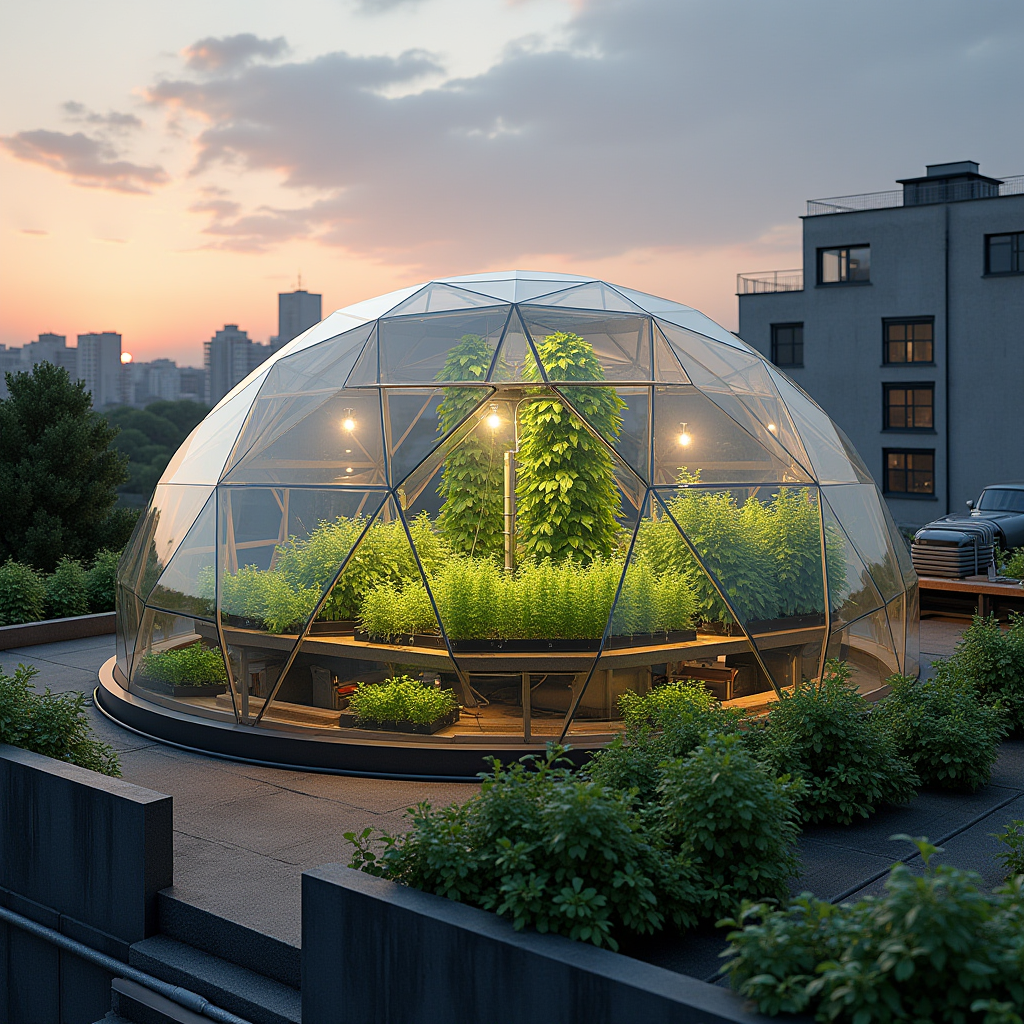
For a practical urban aquaponic dome, a 5.5–6.5 m (18–21 ft) diameter is a sweet spot: big enough for real biomass and thermal mass, small enough to permit as an accessory structure in many municipalities.
Key design choices:
- Frame: Galvanized steel or aluminum hubs and struts are more code-friendly than DIY timber in most cities. Check local snow and wind loads and pick a dome kit that is rated accordingly.
- Skin: Twin-wall or triple-wall polycarbonate on the north side, high-quality greenhouse film on the south side if you want to balance cost and insulation, similar to energy-efficient designs described in this energy-efficient aquaponics greenhouse guide.
- Foundation: Ground anchors with a perimeter grade beam or small concrete piers often meet code for “temporary” or accessory structures, but verify frost depth and anchoring requirements.
Step 2: Layout - central water mass, ring of plants, clean service paths
A practical dome layout uses concentric rings:
- Center: Main fish tank(s) plus sump, as thermal mass.
- Inner ring: Biofilter, mechanical filtration, degassing, and main manifold.
- Outer ring: Growing systems - DWC rafts, NFT channels, and vertical towers. Kratky-style totes can live here too for low-demand crops.
- Perimeter: Access path and low storage, keeping the shell clear for airflow and maintenance.
This puts the heaviest equipment at the structural center, keeps plumbing runs short and symmetrical, and leaves clear arcs of air above plant rows for fans and ducting.
Step 3: Match fish stocking to biofilter and plant capacity
Use feed-first logic. Here is a simple, conservative starting blueprint for a 6 m dome geared toward leafy greens and herbs using DWC/NFT (numbers are for illustration, always tune with local advice and calculators like those compiled in these aquaponics calculators):
- Fish: 800–1,000 L main tank with 20–25 kg of tilapia or similar warmwater species at full grow-out.
- Feeding: 0.8–1.0% of biomass per day at maintenance, up to 1.5% at strong growth. For 25 kg fish, that is roughly 250–375 g feed per day.
- Biofilter media: For typical high-surface media (500–800 m²/m³), a safe rule of thumb for small domes is around 1–2 L of media per gram of daily feed. At 300 g feed, that is 300–600 L of active biofilter media in moving bed or trickle form.
- Plant area: Leafy greens and herbs generally use about 40–60 g of feed-derived nitrogen per square meter of active growing area per month in a balanced aquaponic system. A 300 g/day feed input can support roughly 20–30 m² of dense greens (DWC/NFT) under steady conditions.
That gives you a matched loop: fish feed rate, biofilter surface, and plant area all sized to avoid chronic nutrient surplus or deficit.
Step 4: Choose hydroponic subsystems that fit the dome
In a geodesic dome, height is your friend. You can stack hydroponic methods around the central fish tank:
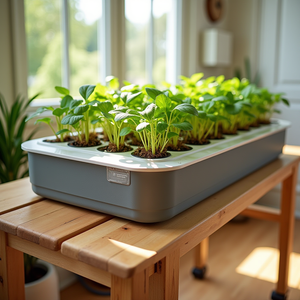
- DWC rafts: 25–40 cm deep channels at floor level, ideal for stable conditions and thermal coupling to water mass.
- NFT channels: Mid-height arcs on light steel or aluminum frames, following the dome curve, for leafy greens and herbs.
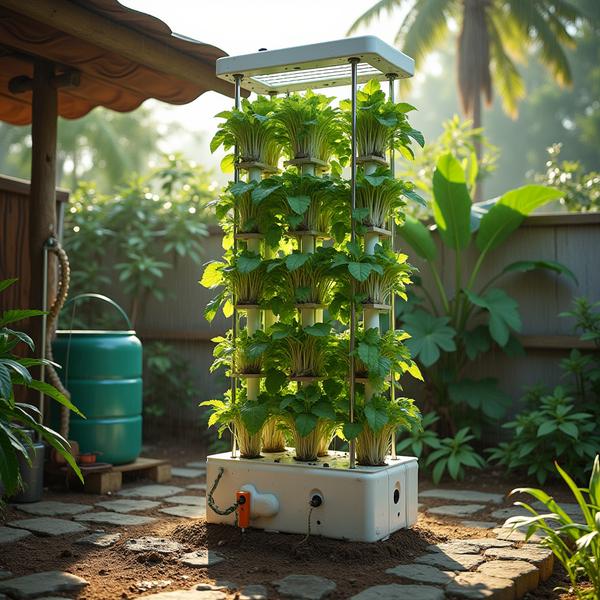
- Vertical towers: Around the perimeter where you have height but not floor space. These can be particularly efficient for leafy crops.
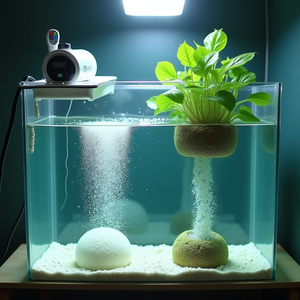
- Kratky totes or jars: For low-demand herbs or trial crops using fixed nutrient levels. In a true aquaponic loop, Kratky is more of a side-experiment unless you dedicate a small reservoir fed from the main system and topped off manually.
Deep water culture, NFT, and tanks should all be integrated around a common sump so total water volume is high and temperature swings are slow.
Step 5: Route water and air with redundancy in mind
A practical dome system uses a low-lying sump at or near the center, with a central pump feeding:
- Fish tank(s).
- Biofilter (moving bed or static media).
- Plant manifolds for DWC makeup, NFT, and towers.
Water flows by gravity whenever possible back to the sump. Keep head heights low to reduce pump energy. For aeration and climate:
- Use dedicated air pumps with ring manifolds to DWC and fish tanks.
- Install at least two high-mounted circulation fans to break up thermal stratification.
- Include one high apex vent (manual or automatic) and low intake vents to drive a chimney effect when hot.

4. Long-term operation: climate, water quality, and permits that stick
Climate control in a geodesic shell
Design your climate control like a simple control loop, not a collection of gadgets. At minimum, you want:
- Sensors: Air temperature and humidity at plant height and near the apex, plus water temperature in the fish tank and one plant loop.
- Actuators: Vents (manual or motorized), circulation fans, exhaust fan, shade cloth (inside or outside), and, in cold climates, a small backup heater sized to protect fish water.
Baseline target bands for a warm-season leafy-green and warmwater fish dome:
- Day air: 22–28 °C with short peaks up to 30 °C if humidity stays below 80%.
- Night air: 16–20 °C.
- Water (fish and DWC): 22–26 °C for tilapia-like species.
- Relative humidity: 60–80% with active airflow.
In summer, your main moves are early-morning venting, shade cloth on the sun-heavy arcs, and continuous air mixing. In winter, you lean on the thermal mass of fish tanks and DWC, insulate the north wall, and reduce air changes to minimize heat loss, a strategy consistent with the “energy-efficient greenhouse” approaches outlined in aquaponic greenhouse design guides.
Water quality: pH, alkalinity, and EC in a dome aquaponic system
In aquaponics, pH and alkalinity drift downward as nitrifying bacteria convert ammonia to nitrate. In a relatively enclosed dome with stable temperatures, this process can be very steady, which is a blessing if you stay ahead of it.
pH management blueprint:
- Target pH 6.8–7.2 to balance fish health and nutrient availability, as many aquaponic manuals recommend, including those summarized in this aquaponics design overview.
- Test pH and KH (carbonate hardness) at least twice a week.
- Use a mix of potassium bicarbonate and calcium carbonate or hydroxide to slowly buffer upward when pH approaches 6.5.
EC and nutrient density:
- Aquaponic systems usually run lower EC than conventional hydroponics: roughly 0.8–1.8 mS/cm depending on crop and stocking density.
- Do not chase hydroponic EC charts. If plants show specific deficiencies (e.g. iron chlorosis), supplement targeted minerals instead of broad nutrient salts to avoid overloading fish with salts.
Dissolved oxygen (DO): Because domes are tight envelopes, hot still days can crush DO if aeration is weak. Keep strong bubbling in both fish tanks and DWC, and consider redundant air pumps on different power circuits.
Permits and urban compliance: a step-by-step approach
Permitting is local, but the process tends to follow the same pattern. Do this in order:
- Zoning check: Confirm that food production, greenhouses, and small-scale aquaculture are allowed on your parcel. Look for restrictions on accessory structures and “livestock.”
- Structure classification: Work with planning/building to agree on the dome as a greenhouse or accessory structure. Show wind and snow ratings from the manufacturer and anchoring details.
- Water and drainage: Document that the system is recirculating, with no routine nutrient discharge to storm drains. Show how emergency overflows are contained.
- Fish and species permits: Check state/provincial fish and wildlife rules. Some cities treat tilapia and similar species as regulated. You may need an aquaculture license or registration if you sell fish.
- Electrical and heaters: Any fixed wiring or gas heaters usually trigger inspections. Keep pumps and controllers tidy, labeled, and protected from splashes.
If you can show that your dome behaves like a smart, closed-loop greenhouse rather than an unregulated fish facility, you are more likely to get buy-in, consistent with how smart urban greenhouses are framed in recent urban agriculture discussions.
Hydroponic loops inside the dome: Kratky, DWC, and NFT for resilience
One advantage of a dome is redundancy. You can mix hydroponic approaches to keep production going even if the fish side has issues:
- Primary loop: Full aquaponic DWC and NFT fed from fish tanks.
- Backup loop: A small independent hydroponic reservoir (with its own nutrients) running a handful of NFT channels or a tower. If fish stocking drops or you are quarantining fish, you still have greens growing.
- Kratky bank: Static totes or jars for greens using simple hydroponic nutrients, ideal for periods when you want zero pump dependence on a subset of crops.
Keep pH and EC separate between aquaponic and pure hydroponic loops. Do not “top up” the fish system with hydroponic salts to chase EC numbers; instead, use targeted supplements and correct any real deficiencies identified through plant symptoms or testing.

Bringing it together: a practical 2026-ready food dome blueprint
If you want a self-sustaining aquaponic dome that holds up past the first season, design it like this:
- A 6 m geodesic shell with rated structure and a mixed polycarbonate/film skin tuned to your climate.
- Central fish tanks and sump, 20–25 kg fish biomass at full load, fed based on water tests, not guesswork.
- Biofilter sized from feed rate and media surface area, not “some barrels should be enough.”
- DWC and NFT rings, plus optional vertical towers, all on a shared loop, with a small independent hydroponic loop as backup.
- Ventilation, shading, and mixing designed around the dome’s natural stratification, controlled by a small but reliable sensor/relay system.
- Permits and species approvals handled early with clear documentation that this is a closed-loop, low-risk smart greenhouse.
Get those fundamentals right and the rest is just dialing in varieties, refining planting schedules, and squeezing a little more yield from every watt and liter.
As an Amazon Associate, I earn from qualifying purchases.