Can Regular LED Bulbs Replace Grow Lights for Hydroponics? Spectrum, PPFD, Safety and When It Works
"LEDs are all the same" is one of the fastest ways to end up with stretched, weak plants over perfectly good nutrients. The bulb over your kitchen bench and the panel over your DWC tote are not doing the same job, and your plants can tell.
This guide cuts through the noise and answers the real question new indoor growers have: when can you get away with regular LED bulbs, when will they absolutely hold your system back, and how do you build a safe, budget lighting setup that actually hits plant targets for Kratky, DWC, and NFT.
Structure of this guide
- Common mistakes with regular LEDs over hydroponics
- Why they happen (spectrum, PPFD, optics, room choice)
- How to fix them on a realistic budget
- What to monitor long term so your lighting never becomes the bottleneck again
1. Common lighting mistakes hydro growers make with regular LEDs
Let’s start with what actually goes wrong in real systems – Kratky buckets on a window sill, DWC totes in a spare room, or NFT channels on a balcony.
Mistake 1: Equating lumens with plant light
Household LED bulbs are sold on lumens and watts, not PAR or PPFD. That works for humans, not plants. Plants care about photosynthetically active radiation (PAR, 400–700 nm), measured as PPFD (µmol/m²/s). A 12 W “daylight” bulb can feel bright to your eyes and still deliver poor PPFD at the canopy.
This is exactly the same confusion people hit with aquarium LEDs: the tank looks bright, but corals or plants stunt because the spectrum and intensity are wrong, as broken down in this LED aquarium overview.
Mistake 2: Ignoring PPFD and DLI targets by crop
Leafy greens, herbs, and fruiting plants do not want the same light. New growers often throw a couple of bulbs above everything and accept whatever happens.
- Leafy greens & herbs (basil, lettuce, cilantro): thrive at roughly 100–300 µmol/m²/s PPFD, with a daily light integral (DLI) around 12–18 mol/m²/day.
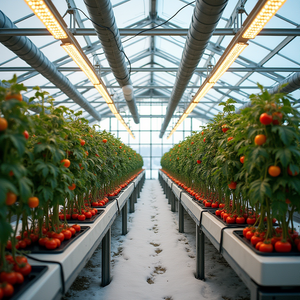
- Heavier feeders (tomatoes, peppers, strawberries): happier at 400–600+ µmol/m²/s PPFD, with DLI 20–30+ mol/m²/day.
Most regular bulbs, even at close distance, struggle to hit the upper leafy green range over any reasonable area, let alone fruiting crops.
Mistake 3: Wrong spectrum assumptions from CCT and CRI
Many people buy “6500 K daylight” bulbs with high CRI and assume they are “full spectrum grow lights”. CCT (Kelvin) and CRI are human-vision metrics. They tell you how white the light looks and how accurately you see colors, not how much plant-usable red and blue the lamp produces.
Plants mainly care about photons in blue (roughly 430–480 nm) and red (roughly 620–680 nm). Plenty of decent white LEDs have big peaks in blue and a broad red tail, but others are weak where your plants need power most.
Mistake 4: Mounting and coverage errors
Even when the bulb itself is usable, it is usually mounted badly:
- Too high above the canopy, so PPFD is low.
- Bulbs pointing straight down on a narrow cone, so edges of the raft or NFT channel are in the dark.
- No reflective surfaces, so most light hits the floor or walls, not leaves.
Gardeners do the same with indoor spaces in general, underestimating how much environment matters. As this piece on selecting an indoor growing space notes, walls, room layout, and reflectivity are part of your lighting system whether you acknowledge them or not.
Mistake 5: Sketchy electrical installs over water
The last big one: people hang bare fixtures and non-rated strips straight over DWC / NFT without GFCI, drip loops, or splash protection. The plants might survive; you might not. Wet environments plus DIY wiring without protection is a hard no.

2. Why these LED problems happen (and what physics is hiding behind them)
Spectrum: household LED vs grow light
Most household LEDs use a blue LED with a phosphor coating to make white light. That gives you a big spike in blue, a broad hump from green to red, and then it falls off. Grow LEDs intentionally boost specific bands:
- Blue (430–480 nm) for compact vegetative growth, strong leaves, tight internodes.
- Red (620–680 nm) for biomass production, stem elongation control, and flowering/fruiting response.
- Optional far-red (700–750 nm) to manipulate shade responses and flowering in some crops.
You can grow plants under all sorts of spectra, but efficiency and morphology change. A typical 4000–6500 K bulb may work for leafy greens if you hit intensity targets, but a tuned horticultural fixture will give you more usable photons per watt and usually better plant form.
Intensity: from watts and lumens to PPFD and DLI
Here is the translation you actually need as a grower:
- PPFD (µmol/m²/s) tells you how many photosynthetic photons hit a given area per second.
- DLI (mol/m²/day) is PPFD integrated over time. It is the “daily dose” of light.
You do not have to become a lighting engineer, but you should know your target ranges:
- Seedlings & low light herbs: 100–150 µmol/m²/s, 10–12 h/day → DLI around 4–6 mol/m²/day.
- Leafy greens in Kratky / DWC / NFT: 150–250 µmol/m²/s, 14–16 h/day → DLI around 8–14 mol/m²/day.
- Light-hungry fruiting crops: 400–600 µmol/m²/s, 14–16 h/day → DLI 20–35 mol/m²/day.
Most household bulbs are not designed to hit 200+ µmol/m²/s over a full 60 × 60 cm tray at a sensible mounting height. They can work for small footprints or single plants, but they run out of steam quickly.
Optics and coverage
Bulbs throw light in a wide pattern, and a lot of it misses the plants. Purpose-built bar or panel grow lights spread light evenly across their rated area, often with secondary optics. If you insist on bulbs, you have to fix coverage with height, spacing, and reflectors, or you get hot spots in the middle and weak edges.
Environment and space choice
Your room choice completely changes how far a given light goes. A bright bulb in a dark, non-reflective room is wasted. A modest fixture in a small, light-colored space is far more efficient. Again, this guide on indoor growing spaces is worth a skim: it highlights how walls, ventilation, and access all feed into lighting performance.
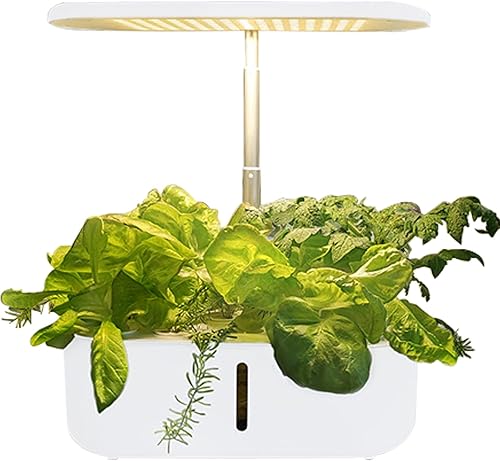
3. How to fix it: when regular LEDs are fine, and when you need true grow lights
When household LED bulbs can work for hydroponics
There are situations where regular bulbs are a smart budget move:
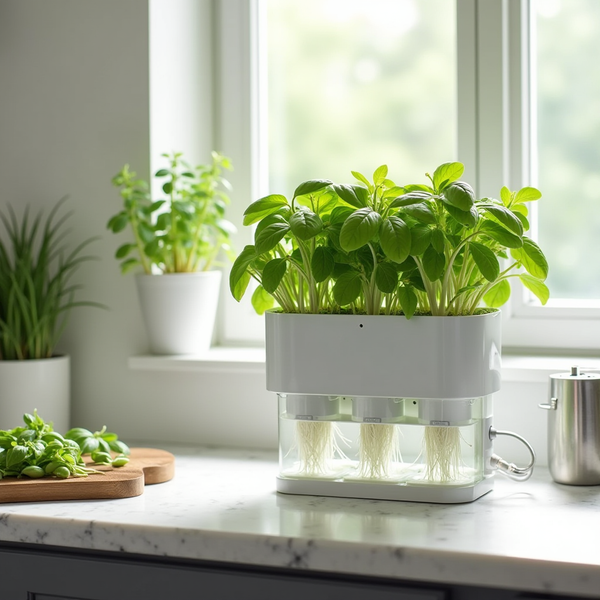
- Very small grows: 1–4 Kratky jars, a single DWC bucket, or a narrow NFT run.
- Crops: Leafy greens and herbs only; no expectation of heavy fruiting.
- Short-term or starter lighting: Raising seedlings before they move to sun or stronger LEDs.
For these use cases, choose:
- CCT: 4000–6500 K “neutral to daylight” white.
- Form factor: A19, BR30, or similar bulbs in clamp lamps or basic fixtures.
- Total power: Somewhere in the 30–50 W range of decent LEDs per 0.25 m² of canopy as a rough starting estimate.
Keep bulbs close (15–25 cm above the canopy), use reflectors or white walls, and run 14–16 hours/day. You will not get commercial growth rates, but your lettuce will be fine.
When you should not rely on household bulbs
Skip regular bulbs and go straight to proper grow lights if:
- You are lighting a tray or tent larger than about 60 × 60 cm.
- You want fast turnarounds and full heads of lettuce or basil every 3–4 weeks.
- You are growing fruiting crops indoors full cycle.
- You do not want to spend time tinkering with fixture spacing and makeshift reflectors.
In these setups, a good bar or board-style LED fixture with known PPFD maps is cheaper in the long run than over-driving a mess of household lamps.
Designing a budget-friendly, plant-first LED setup
Option 1: Affordable full-spectrum grow panels
This is the simplest route. Look for:
- Published PPFD values at realistic hanging heights.
- Coverage that matches your system footprint (e.g., 60 × 60 cm tent or shelf for a small NFT rail or DWC tote).
- Power draw around 100–150 W for a 60 × 60 cm area of leafy greens.
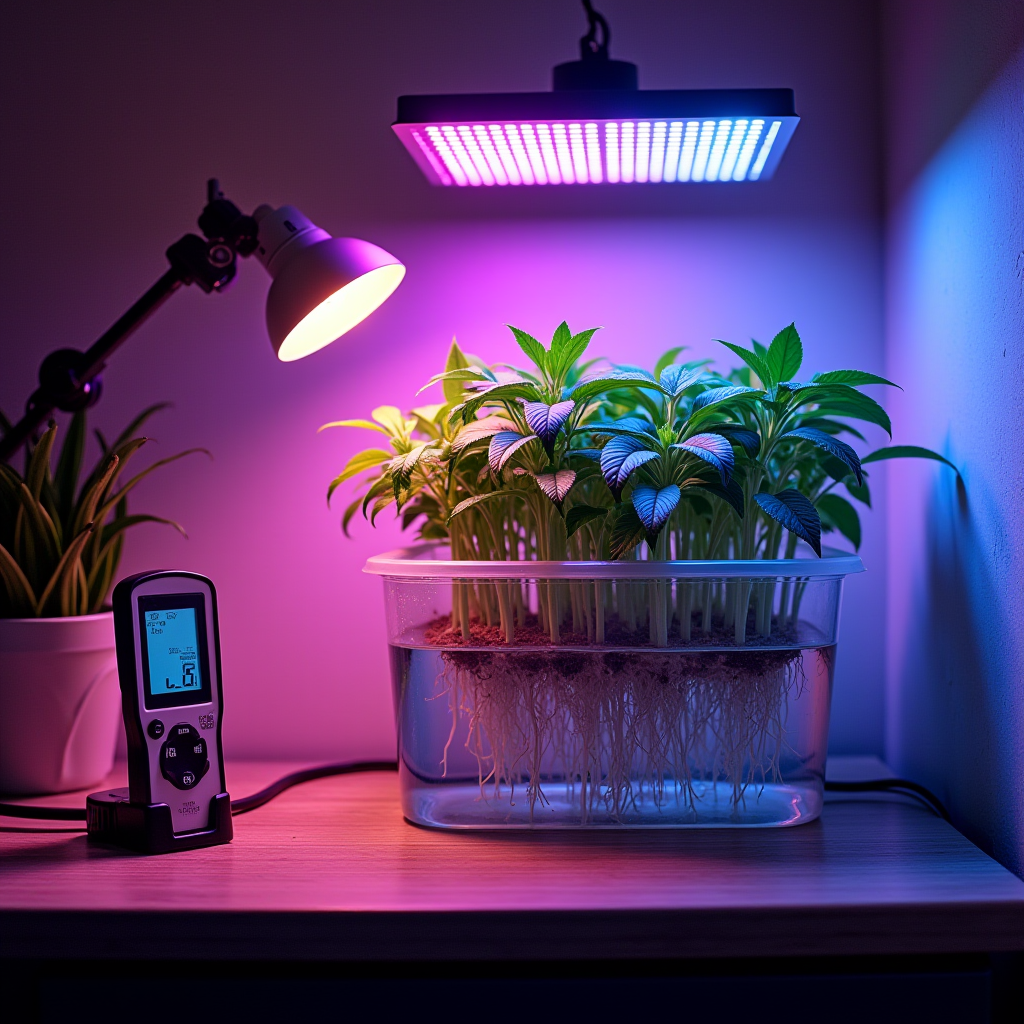
Mount the panel 25–40 cm above the canopy, and adjust by watching plant response (too much light: leaves taco or bleach; too little: stretch and pale growth).
Option 2: DIY LED strip build for racks and balcony rails
For micro-Kratky jars, shallow DWC tubs, and NFT channels on shelves, LED strips are hard to beat.
What to use:
- 24 V or 12 V LED strips, “full spectrum” or 4000–5000 K white with decent efficacy.
- A matched power supply with some headroom (do not run at 100 % rated load).
- Aluminum channels or flat bar as a heatsink and mounting spine.
- A basic timer for photoperiod control.
Layout tips:
- Run multiple parallel strips over each row so that light is even from edge to edge.
- Mount 15–30 cm above the plant tops to balance spread and intensity.
- Plan roughly 25–35 W of decent-quality white LED strips per 0.25 m² for leafy greens as a starting point, then fine-tune by plant response.
This kind of DIY build gives you wide coverage, good efficiency, and enough flexibility to match different hydro layouts.
Hydro system specifics: Kratky, DWC, NFT
- Kratky: Very sensitive to stretch, because plant height is fixed relative to the lid. Keep light closer and intensity adequate so plants bulk up instead of reaching.
- DWC: Plants can get big fast with good oxygen and nutrients, so do not starve them of light. Plan your fixture for full canopy width from day one.
- NFT: Channels are long and narrow. Use linear fixtures or strip lights that follow the channel, or stagger multiple bulbs for overlap so the ends do not lag behind the center.
4. What to watch long term: safety, consistency, and tuning
Safety over DWC and NFT: GFCI, IP ratings, and basic wiring discipline
Any time you hang lights over water, even “low voltage” strips, treat it like a wet-location electrical install.
- GFCI protection: Plug your power strips and drivers into GFCI outlets or use an inline GFCI adapter. Test them monthly.
- Drip loops: Ensure every cord dips below the outlet height before rising to the socket, so water cannot run down into plugs.
- Ingress protection: Use fixtures or strips with at least IP65 (splash-resistant) if they are anywhere near spray, mist, or condensation.
- Enclosures: Keep drivers, power supplies, and junctions outside the immediate splash zone, in ventilated but protected boxes.
- Strain relief: No hanging fixtures from cords. Use chains, brackets, or racks to carry the load.
These are the same principles you would follow mounting fixtures over a planted aquarium or sump. Do it once, do it right.
Monitoring plant response instead of chasing specs
Light meters are nice, but your plants are already reporting back.
- Under-lighting signs: Stretching, large internode gaps, thin stems, pale or flat leaves reaching toward the light.
- Over-lighting signs: Leaf edge curl or “taco”, bleached spots, or leaves that feel dry and papery despite good nutrients.
- Uneven coverage: Plants at the edges lag behind the center of the raft or channel.
Make small, deliberate changes: lower or raise the fixture by 5–10 cm, extend or shorten the photoperiod by 1–2 hours, and give plants a week to respond before you change anything else.
Balancing light with nutrients and environment
If you increase light intensity, plants will demand more nutrients and oxygen. In practice:
- Kratky: Use a slightly stronger nutrient mix and make sure your starting solution volume is big enough so EC does not spike as water drops.
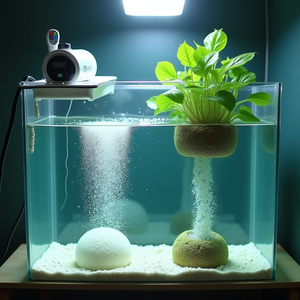
- DWC: Confirm your air pump and stones are providing vigorous aeration; bump EC modestly if new growth pales but pH stays stable.
- NFT: Ensure the flow rate is high enough that channels never run near dry during peak transpiration in bright light.
Lighting is one gear in the machine. When you turn it up, tune the rest of the system with it.
Simple baseline recipes you can rely on
To keep things practical, here are working baselines that cover most home setups:
- Leafy greens & herbs in Kratky / DWC / NFT
- LED: 150–250 µmol/m²/s at the canopy from either a full-spectrum grow light or a dense grid of white LED strips.
- Photoperiod: 14–16 h/day.
- Environment: 18–24 °C air, 5.8–6.2 pH, EC ~0.8–1.4 mS/cm depending on crop and stage. - Fruiting crops in recirculating hydro
- LED: 400–600 µmol/m²/s at canopy from a rated grow fixture.
- Photoperiod: 14–16 h/day for vegetative, 12–14 h/day for fruiting if you want to save power.
- Environment: 20–26 °C air, 5.8–6.2 pH, EC ~1.8–2.4 mS/cm depending on species and phase.
Once you are in these ranges, fine-tuning is about observing your plants rather than buying more hardware.
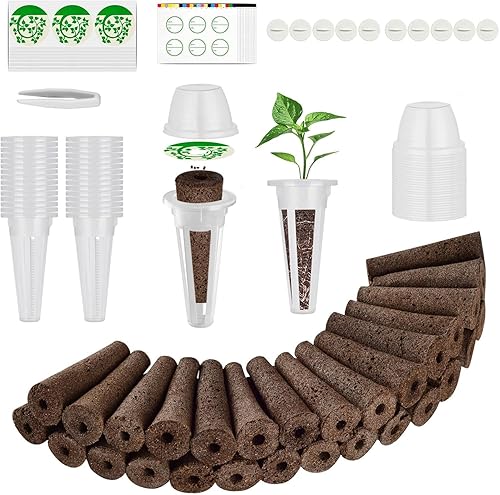
To wrap it up: yes, regular LED bulbs can stand in for grow lights in specific, low-demand situations if you respect PPFD, coverage, and safety. For anything beyond small leafy-greens projects, purpose-built grow fixtures or well-designed LED strip builds will pay you back fast in speed, yield, and reliability. Treat light as a measurable input, not a guess, and your Kratky tubs, DWC buckets, and NFT rails will show you what they are really capable of.
As an Amazon Associate, I earn from qualifying purchases.