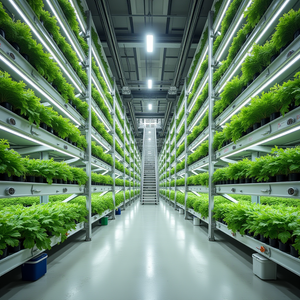
Most indoor farms think “add more batteries” when power bills spike. In 2026, the smarter move is to fix the way you move solar power, not just how you store it.
AC-heavy grow facilities are bleeding energy in unnecessary conversions. If you’re pushing high-density LEDs, DWC air pumps, and tight climate control, every 5‑10% loss at an inverter shows up as higher operating cost and less headroom on constrained grids.
DC-coupled solar microgrids are finally practical at farm scale, thanks to more mature high-voltage DC hardware and building-integrated concepts coming out of hydro-ecological urban projects, as seen in designs like Qing Duan’s vertical systems (concept overview) and recent sustainability research trends (sustainability news).
This guide walks through the real mistakes growers make when trying to bolt solar onto indoor hydroponics, then shows you how to design a DC-focused system that actually matches how LEDs, pumps, and HVAC really run in a grow.
1. Common design mistakes with solar for indoor hydroponic farms
1.1 Treating your farm like a “normal” building load
Most solar installers size arrays as if they’re feeding offices or homes. Indoor farms are different:
- Loads are dense and clustered: 200–450 W/m² of LED power in vertical racks is normal.
- Photoperiod-driven: 12–20 hours/day of fairly flat LED demand, not the random peaks of office equipment.
- Water systems don’t sleep: DWC air pumps, circulation pumps, and dosing systems often run 24/7.
- HVAC tracks lights, not people: Heat from LEDs and pumps sets the HVAC curve.
If your designer uses “kWh/m² of floor area” from commercial benchmarks, you’ll end up with a PV system that covers the office, not the grow.
1.2 Locking everything into AC when most loads want DC
Reality inside a serious indoor farm:
- Modern LED drivers rectify AC to DC immediately.
- Most EC/pH controllers, sensors, valves, and logic run off 12–48 V DC internally.
- Smaller pumps and blowers are increasingly available with brushless DC motors.
If you run PV → DC → AC (inverter) → DC (driver) for everything, you stack conversion losses:
- 2–4% in the PV DC/DC stage.
- 3–6% in the inverter.
- Additional loss inside each LED driver or DC supply.
Add batteries on AC, and you repeat the penalty in both directions. Over a year, that can easily erase 8–15% of your generation.
1.3 Sizing solar by roof area instead of by grow schedule and load
Another common mistake is “fill the roof with PV and call it good.” That ignores:
- Your latitude and seasonal sun hours.
- Your exact photoperiod (e.g., 18/6 vs 12/12 for cannabis; 16/8 for leafy greens).
- How much HVAC power is driven by light-on vs light-off periods.
For an indoor DWC lettuce setup at 200 W/m² of LED density and 16/8 lighting, you might see LED energy use of 3.2 kWh/m²/day, plus about 30–60% more in HVAC. If your solar designer is just quoting “X kWp fits on the roof,” you’re flying blind.
1.4 Ignoring DC-compatible hardware for LEDs and pumps
There is now a healthy ecosystem of DC-native components:
- LED drivers that accept DC bus inputs (e.g., 380–480 V DC).
- DC-input variable-frequency drives (VFDs) for larger irrigation and HVAC pumps.
- Native DC power supplies for control gear at 24–48 V DC.
Too many farms still buy only AC-input lights and pumps, then wonder why their “green” system is saddled with multiple inverters and conversion hardware that fails at the worst time.
1.5 Treating HVAC as an afterthought instead of a co-equal design partner
LED efficacy has improved dramatically, but nearly all input power still becomes heat inside your grow envelope. For a pump-heavy DWC or NFT room:
- Almost 100% of LED wattage becomes heat.
- Much of pump and air stone energy ends up as heat in the nutrient solution and air.
If you size solar for LEDs and pumps but ignore HVAC, your chillers and dehumidifiers will still demand big chunks of grid power whenever lights are on. That defeats the purpose of the microgrid and risks climate instability if the grid wobbles.
2. Why these mistakes actually happen
2.1 Solar engineers and growers speak different “time languages”
Solar folks think in annual kWh, monthly bills, and net-metering. Growers think in photoperiods, veg/flower phases, and DLI. Those are not the same.
For example, a lettuce DWC room might run:
- Lights: 16 hours on / 8 hours off, nearly flat draw.
- Air pumps: 24/7 for oxygen-critical roots.
- Circulation pumps: duty cycles that track tray fill/drain.
- Dehumidifiers: hardest during lights-on, lighter but nonzero at night.
If your solar designer only sees “40,000 kWh/month,” they miss the waveform that determines how much of that can be matched by same-time solar and how much needs storage or grid support.
2.2 Ingrained AC bias in buildings and codes
Most building services, electrical contractors, and safety inspectors are trained around AC distribution:
- AC panels, breakers, and subcircuits are standard and well understood.
- DC at 380–1,000 V is perceived as exotic or “data center only.”
- Permitting offices may not even have a checklist for farm-scale DC microgrids.
This pushes many designs into the comfort zone: big AC bus, one or two inverters, and AC-only loads. You pay for that comfort in energy lost as heat and in conversion hardware failures.
2.3 Underestimating HVAC’s share of the energy pie
In a modern insulated building, lights and HVAC can each be 30–50% of total energy. For a high-density indoor farm, lighting can be 40–60% and HVAC 25–40%, with pumps and controls making up the rest.
Studies on urban and vertical farming systems highlight how tightly energy, water, and climate control are coupled in dense indoor agriculture (urban hydro-ecological architecture overview). If your microgrid design is “LED-centric” but leaves HVAC on the legacy AC side, you lock in a structural dependency on the grid.
2.4 Fear of “complicated” DC safety
High-voltage DC arcs don’t self-commutate like AC. That scares a lot of electricians. In practice, the industry has already solved this for PV and data centers:
- DC-rated breakers, contactors, and disconnects.
- Arc-fault detection and rapid shutdown for rooftop strings.
- Pre-engineered DC busway and connector systems.
What’s often missing is a clean design that limits who touches the DC side and how it is segmented, not some magical new hardware.
3. How to fix it: a practical DC microgrid design for an indoor hydroponic farm
3.1 Start with your load model, not your roof
Pick one grow room and build a simple spreadsheet. You need:
3.1.1 LED load
- Installed LED power: W/m² and total m² of canopy.
- Photoperiod: hours/day per stage (veg vs flower or leafy vs fruiting).
- Control strategy: dimming schedules, sunrise/sunset ramps, spectrum shifts.
Example for a 100 m² DWC lettuce room:
- LED density: 220 W/m².
- Total LED power: 22 kW.
- Photoperiod: 16 h/day.
- Daily LED energy: 22 kW × 16 h = 352 kWh/day.
3.1.2 Hydroponic system loads
Break these out so you can decide which run on DC:
- DWC air pumps: often 0.5–2 kW total, 24/7.
- Circulation pumps: sum all pumps in sumps, distribution, and returns.
- Dosing systems: nutrient and pH dosing pumps, usually low power but mission-critical.
- Control and monitoring: EC/pH controllers, PLCs, gateways, cameras.
As a rule of thumb for leafy greens in DWC or NFT:
- Pumps and aeration often add 5–15% on top of LED energy, depending on redundancy.
- Controls and IT are usually under 2% but belong on a protected DC bus.
3.1.3 HVAC and dehumidification
Work with an HVAC engineer who understands CEA (controlled environment agriculture). Ask for:
- Sensible and latent loads at lights-on vs lights-off.
- Estimated kW for chillers/heat pumps, fans, and dehumidifiers at design conditions.
- Part-load performance curves or COP/EER vs load.
For a well-insulated room at 22 kW LED and ~3 kW of pumps/control heat, expect peak HVAC electrical demand somewhere in the 15–25 kW range for cooling and dehumidification, depending on setpoints and local climate.
3.2 Choose safe, practical DC bus voltages
Design around two or three DC levels:
- High-voltage DC bus (HVDC): 380–1,000 V DC for main distribution to LED drivers and large VFDs.
- Medium DC bus: 48–120 V DC for mid-size pumps, fans, and some dehumidification components if available.
- Low-voltage DC bus: 24 V DC (and sometimes 12 V) for control, sensors, dosing, and network hardware.
Common, field-tested architecture in 2026 looks like this:
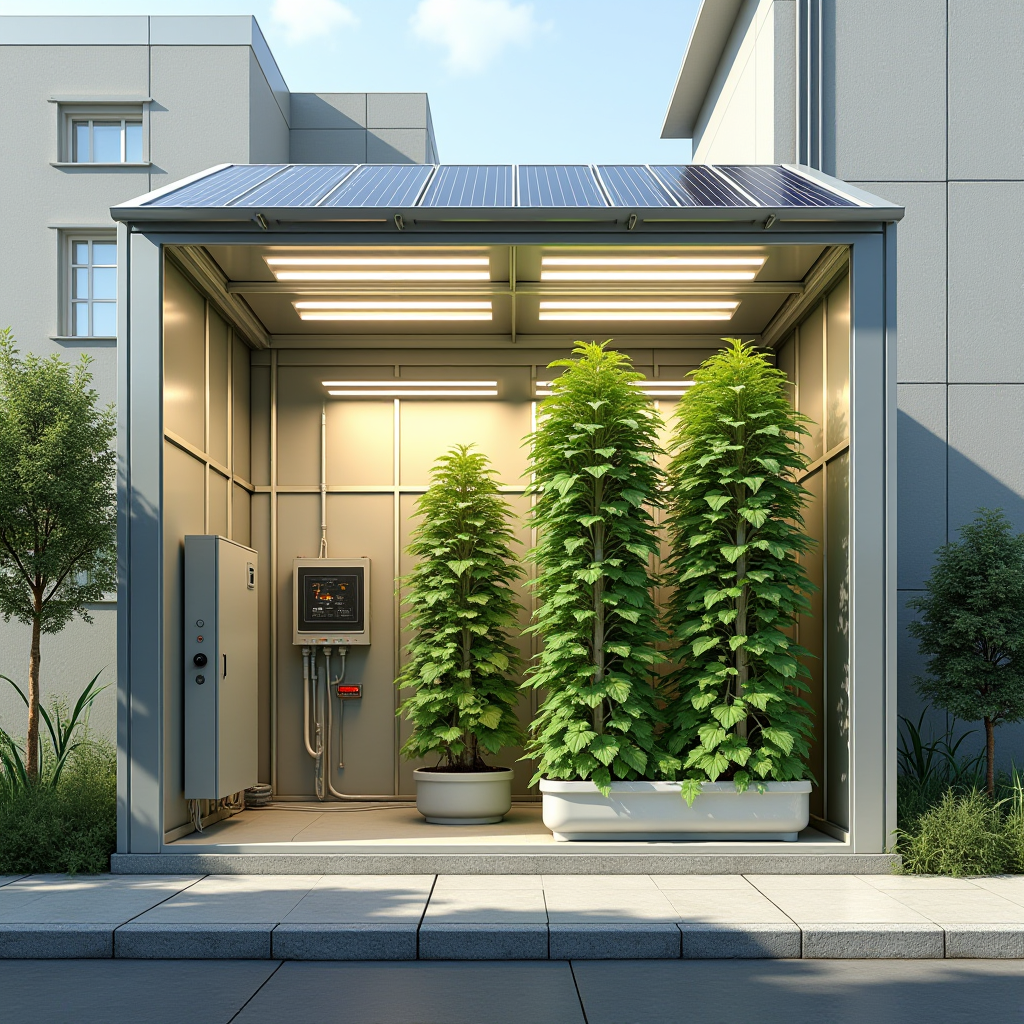
- PV strings feed a DC combiner and DC/DC stage that stabilizes a ~750 V DC bus.
- LED drivers and DC-input VFDs connect directly to that bus.
- A DC/DC converter steps down to 48 V and 24 V for smaller loads and control.
- Batteries connect on DC (DC-coupled), minimizing double conversions.
At each level, you use DC-rated breakers, disconnects, and fault detection just like in a large PV plant or data center.
3.3 Select DC-compatible LEDs, pumps, and VFDs
3.3.1 LEDs
When specifying fixtures, insist on one of the following:
- Drivers with DC input option (e.g., 250–1,000 V DC bus).
- Modular bars or panels that can be driven by centralized DC drivers.
In practice:
- Group lights by rack or zone so you can feed each group from a dedicated DC branch.
- Use dimming protocols that don’t require separate AC gear (e.g., 0–10 V over DC, or digital bus).
3.3.2 Pumps and aeration
For small DWC air pumps and nutrient pumps (under ~1 kW):
- Look for brushless DC models that run on 24–48 V DC.
- Feed them from the 48 V DC bus with fuses and isolators.
For larger irrigation or HVAC pumps (1–15 kW):
- Use DC-input VFDs tied directly to the HVDC bus.
- Design your piping and head pressures to operate efficiently at variable speed.
This lets you run the bulk of your hydraulic energy without bouncing through inverters.
3.3.3 Control, sensors, and automation
All the stuff that keeps plants alive when you’re not looking should live on a robust low-voltage DC bus:
- 24 V DC for EC/pH controllers, nutrient dosing, and valve actuation.
- 24–48 V DC PoE for cameras and network switches.
- Redundant DC power supplies with automatic failover.
That low-voltage DC bus should be supported by the DC-coupled batteries with prioritized uptime, so your Kratky buckets and DWC tanks don’t go oxygen-dead just because the grid tripped for an hour.
3.4 DC-coupled PV + battery: the generation-side backbone
You already know batteries matter, but here we keep the focus on how they’re wired relative to the PV and loads.
A robust 2026 architecture:
- PV array feeds a central DC bus via MPPT DC/DC converters.
- Battery system connects directly to the DC bus through a bidirectional DC/DC converter.
- DC loads (LEDs, pumps, DC VFDs, controls) connect directly to DC bus levels.
- AC inverter(s) serve legacy AC loads and grid interconnection, not the whole farm.
Advantages over AC-coupled designs:
- Fewer conversions for DC loads: PV → DC bus → LED driver, not PV → AC → DC.
- Battery can serve DC loads without touching AC inverters.
- Simpler islanding: in a grid outage, DC bus stays up and can feed critical systems while AC islanding logic handles the rest.
This type of architecture aligns with trends in building-integrated systems highlighted at recent technology showcases (solar tech overview), where DC distribution is being used to cut conversion losses and improve reliability.
3.5 Integrate HVAC properly without compromising climate stability
HVAC is tricky because off-the-shelf equipment is almost all AC-input. You have three practical options:
- AC HVAC with dedicated high-efficiency inverters
Keep HVAC on AC, but give it a separate, high-efficiency inverter sized for its peak demand. You still feed that inverter from the DC-coupled battery and PV bus. - Hybrid AC/DC HVAC
Some modern variable-speed heat pumps and chillers already use internal DC buses and might accept DC-coupled front ends with vendor support. This is emerging and requires coordination with manufacturers. - DC-side thermal storage
Use DC-coupled PV and batteries to overcool or pre-condition thermal storage (eutectic plates, water or glycol tanks) during peak sun, then coast through dark hours with reduced compressor runtime.
Whatever you choose, protect climate stability:
- Segment your loads into critical (climate control, aeration, circulation) vs deferrable (non-critical lighting, some dehumidification stages).
- In a partial power situation, your control system should gracefully dim or sequence non-critical lights before it allows root temperatures or humidity to drift into danger zones.
3.6 Practical solar sizing against photoperiod and HVAC
Once you have your load model, you can size PV in a way that makes sense for a hydroponic farm instead of a generic building.
For each room or group of rooms:
- Calculate daily energy for LEDs based on photoperiod.
- Add pumps and controls, usually 5–20% of LED energy.
- Add HVAC energy based on heat loads and COP/EER.
- Decide what fraction of each category you want solar to cover on average (e.g., 70% of LED + 50% of HVAC + 100% of controls).
- Use local solar insolation data (kWh/kWp/day) and DC-side losses to back-calculate required PV kWp.
Example, again for a 22 kW LED, 100 m² lettuce room at a decent solar site (say, 4.5 kWh/kWp/day average):
- LEDs: 352 kWh/day.
- Pumps/controls (15%): ~53 kWh/day.
- HVAC (40% of LED + pump heat): ~160 kWh/day.
- Total: ~565 kWh/day.
If you want PV to cover on average:
- 80% of LED energy.
- 80% of pumps/controls.
- 50% of HVAC.
Target solar coverage: 0.8 × 352 + 0.8 × 53 + 0.5 × 160 ≈ 432 kWh/day.
Required DC-coupled PV size:
- Adjust PV yield for DC-side losses: assume 85% net (array to DC bus after wiring, temp, DC/DC).
- Effective daily output per kWp: 4.5 × 0.85 ≈ 3.8 kWh/kWp/day.
- PV kWp for this room: 432 / 3.8 ≈ 114 kWp.
If your building has multiple rooms, you can diversity their schedules or accept partial coverage per room while sharing a common DC backbone.

3.7 DC-side reliability and maintenance basics for growers
Design the DC system so your farm team can operate it safely day-to-day, while specialists handle the deeper work.
- Segmented DC zones: Divide the HVDC bus by room or function with clearly labeled DC breakers.
- Simple “kill switches”: Room-level emergency DC disconnects for LED and pump feeds.
- Redundant control power: Dual 24 V DC supplies with health monitoring for automation and sensors.
- Clear monitoring: Use the same SCADA or farm dashboard to show PV generation, DC bus status, and critical load power.
Regular tasks your grow techs can handle once trained:
- Visual inspection of DC combiner boxes for heat or discoloration.
- Checking DC breaker status and logging trips.
- Routine cleaning of PV surfaces where appropriate for your roof type.
4. What to watch long-term: benchmarks, upgrades, and future-proofing
4.1 Efficiency benchmarks you should actually track
A DC microgrid is only “worth it” if it improves key performance metrics:
- kWh of electricity per kg of product (by crop and system: Kratky, DWC, NFT).
- PV self-consumption ratio: % of solar used on-site vs exported.
- Conversion loss estimate: Compare PV energy at array vs usable DC energy at LED and pump buses.
- Unplanned downtime caused by power events (number and duration per year).
For a well-designed DC-coupled system, you should see:
- 5–10% lower total electricity consumption for the same crop output compared to AC-only distribution.
- Higher percentage of PV energy going directly into LED and pump loads.
- Fewer “mystery failures” of drivers and pumps due to cleaner power and fewer conversions.
4.2 Planning for scale: modular rooms and repeatable DC designs
If you plan to expand, standardize your DC microgrid “recipe” per room:
- Define a typical LED and pump density for each module (e.g., 100 m² DWC module).
- Predefine DC bus branch sizes, breakers, and connectors.
- Use repeatable control panels and DC power stacks.
This mirrors how some vertical farming concepts treat each rack or room as a repeatable unit of architecture and services (architectural concepts), but grounded in electrical reality.
4.3 Integrating future tech: agrivoltaics, façades, and storage innovations
Over the next few years, expect more:
- Building-integrated PV (BIPV) in façades and greenhouse glazing.
- Hybrid agrivoltaic concepts where PV shading is part of the climate strategy.
- Improved battery chemistries and possibly DC-native thermal storage integration.
If your farm already has a clean DC backbone, adding new generation or storage types usually becomes a matter of:
- Adding DC/DC interfaces tuned to that technology.
- Updating controls, not ripping out AC switchgear and redoing everything.
4.4 Compliance, safety, and staff training
High-voltage DC is safe when designed and operated properly, but it requires discipline:
- Work with designers familiar with PV plant and data center DC standards.
- Involve your local inspector early with clear single-line diagrams and protection schemes.
- Train staff on:
- Lockout-tagout procedures for DC and AC.
- Recognizing DC hazard labels and disconnects.
- Basic troubleshooting steps and when to call a specialist.
Done right, your growers should never be poking inside HVDC cabinets; they should be using labeled disconnects and watching dashboards, not playing electrician.

4.5 Aligning with sustainability goals and certifications
As cities push for low-carbon food and buildings, a DC-coupled solar microgrid can be a strategic asset:
- Higher on-site renewable usage and lower transmission losses.
- Better alignment with net-zero energy and carbon targets.
- Potential compatibility with emerging green building and urban agriculture certifications that emphasize efficient energy distribution and resource use.
Research on sustainable infrastructure is increasingly highlighting integrated approaches where energy, water, and food production are co-designed rather than bolted together after the fact (sustainability research highlights). A DC microgrid that is tuned to your hydroponic loads fits that direction.
Bringing it together
A DC-focused solar microgrid is not a science experiment anymore. It’s a practical way to:
- Cut losses between PV array and LEDs/pumps.
- Keep nutrient circulation and climate control alive during grid events.
- Make your indoor or balcony hydroponic operation genuinely more sustainable, not just “solar-branded.”
Start by modeling your grow room loads properly, choose DC-compatible hardware for the big consumers, and design your PV and batteries around a DC backbone instead of an all-AC default. Once that’s in place, your energy storage and future upgrades get easier instead of harder.
As an Amazon Associate, I earn from qualifying purchases.