DIY Semi‑Hydro Self‑Watering Grow Bags (SIP): Convert Sack Farming into a High‑Yield, Low‑Water System
The common mistakes that waste water and stunt sack-farming yields
“Self-watering” sacks are often treated like magic. Fill with soil, poke a few holes, add water from the top, and hope the plants sort it out. In reality, most sack and bag systems quietly waste water, swing wildly in EC, and top out at mediocre yields.
That is a big problem right now, because sack-style growing is scaling fast. In Kaduna, local women are being trained to use sack farming to grow vegetables and build income in tight urban spaces, as reported in this Kaduna program. Jakarta is pushing sustainability and food awareness in schools, including practical growing projects, as highlighted in this coverage of Jakarta’s eco‑aware student initiatives. When thousands of new growers adopt sack systems, the difference between “works okay” and “dialed‑in semi‑hydro” is massive.
The good news: you do not need pumps, timers, or pressurized lines to get hydroponic‑like control. By converting soil sacks into semi‑hydro self‑watering grow bags (sub‑irrigated planters, or SIPs) using coco/perlite and a wicking reservoir, you can stabilize moisture, tighten EC, and cut daily labour down to quick reservoir checks.
Before the build plans, let’s strip out the big mistakes that hold these systems back.

Why these mistakes show up in sack farming and “DIY self-watering” bags
Mistake 1: Treating soil sacks like hydroponics
Most sack farming starts with soil or compost. That works, but it behaves nothing like coco/perlite. Soil packs, drains slower, and holds nutrients very differently. When you try to “fertigate” soil sacks like hydro, salts can accumulate high in the column and root zones see spikes in salinity. Excess salts pull water out of root cells, causing stress and burn, as noted in this explanation of salinity damage.
Mistake 2: No defined reservoir or wick path
Many “self‑watering” sacks are just bags with holes in the bottom sitting in a shallow tray. There is no clear lower reservoir and no proper wicking zone. Water either rushes out or the bottom turns anaerobic. Root health swings from drought to suffocation.
Mistake 3: Over‑top watering that destroys capillary balance
Once the top looks dry, beginners dump water from above, collapsing the air-filled pores in the medium. That ruins capillary distribution and leaves the middle of the bag wet and the top still drying too fast. In semi‑hydro, you want the reservoir and wicks doing the heavy lifting, not constant top soaking.
Mistake 4: Guessing at EC and pH
Sack growers often rely on “a splash of fertilizer in a bucket” with no EC or pH reading. In hydroponic-style coco/perlite systems, that is asking for trouble. The whole point of going semi‑hydro is predictable nutrient availability. Without EC and pH control, you are flying blind.
Mistake 5: No plan for salt management
Self‑watering systems are fantastic at reducing water use, but that also means fewer opportunities to flush out accumulated salts. Over time, that can lead to tip burn, stunting, and mystery deficiencies that are actually toxicity issues. Precision container growers talk about “steering” EC and runoff to maintain balance, as described in this piece on plant steering in container systems. SIP grow bags are no different: you need a salt exit strategy.

How to fix it: a practical SIP grow bag design for semi‑hydro coco/perlite
Now we turn sack farming into a stable, semi‑hydro system that behaves predictably and squeezes more yield out of every litre of water.
1. Choose your container and basic layout
- Bag size: For tomatoes and peppers, use 25–40 L (7–10 gal) grow bags or sturdy sacks. For leafy greens, 10–20 L (3–5 gal) is plenty.
- Bag type: Breathable fabric or woven poly sacks work well. They need enough strength to stand upright when full.
- Reservoir location:
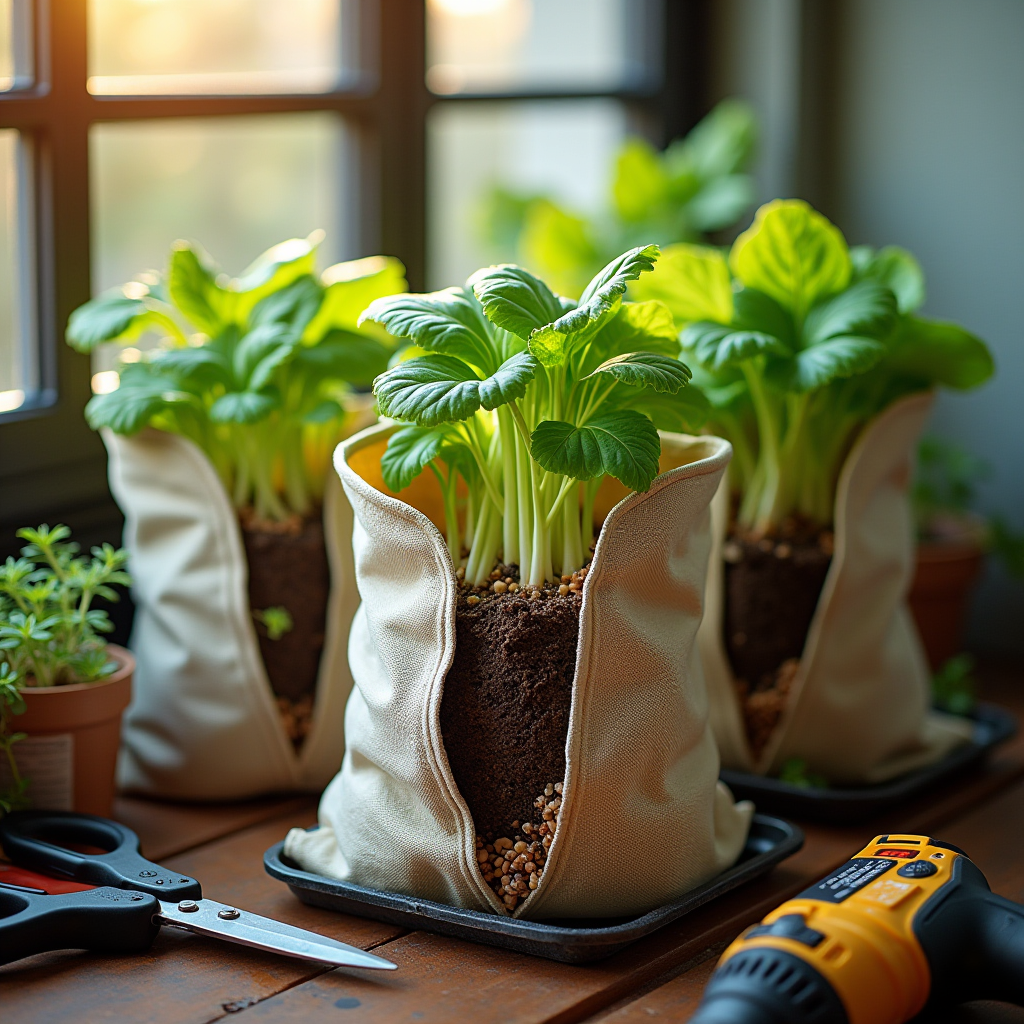
- Option A: Bag sitting inside a rigid tote or basin acting as the reservoir.
- Option B: Bag modified with an internal false bottom to create an integrated reservoir.
- Overflow control: Always drill an overflow hole in the reservoir wall so the level never floods the entire root zone. Set this 3–5 cm below the bottom of the coco/perlite column.
2. Dial in coco/perlite ratios for semi‑hydro
Coco and perlite behave differently from soil. They are inert, so everything the plant gets is coming from your nutrient solution.
- Standard mix for most crops: 70% coco coir : 30% perlite by volume. Good water retention, good air.
- Hot, dry balconies/rooftops: Up to 80% coco : 20% perlite to hold moisture longer.
- Cooler, humid rooms: 60% coco : 40% perlite for more air and faster drainage.
Rinse buffered coco well to remove excess salts before use, especially if you are running low flush frequencies.
3. Size the reservoir properly
For pump‑free SIPs, reservoir sizing is your main lever for labour and stability.
- Leafy greens / herbs in 10–20 L bags:
- Reservoir volume: 3–6 L per bag.
- Refill interval: 3–7 days typical, depending on climate.
- Peppers, eggplant, bush tomatoes in 25–40 L bags:
- Reservoir volume: 8–15 L per bag.
- Refill interval: 2–5 days in hot conditions, longer indoors.
- Rule of thumb: Aim for roughly 25–40% of the total container volume as reservoir space in SIP mode. That gives decent buffering without turning the whole bag into a swamp.
4. Build reliable wicks
Capillary performance is where most “self‑watering” designs fail. You want multiple, redundant wick paths.
- Media wicks: Let 5–10 cm of the coco/perlite column sit directly into the reservoir. This is your primary wick.
- Fabric wicks (optional but powerful):
- Use polyester felt, capillary matting, or strips of non‑rotting fabric.
- Run 2–4 strips per bag from the reservoir up into the lower third of the media.
- Ensure full contact with both the reservoir and media. No air gaps.
- Avoid: Cotton or jute wicks. They rot and can go anaerobic.
5. EC and pH targets for semi‑hydro SIP bags
Think of this system as a slow‑moving, buffered hydro reservoir under each plant. You want conservative, stable EC and tight pH control.
- Greens (lettuce, spinach, Asian greens, basil):
- EC: 0.8–1.3 mS/cm.
- pH: 5.8–6.2.
- Tomatoes, peppers, eggplant:
- EC vegetative: 1.6–2.0 mS/cm.
- EC flowering/fruiting: 2.0–2.4 mS/cm if plants look happy.
- pH: 5.8–6.3.
- Seedlings and young transplants:
- EC: 0.6–0.9 mS/cm.
- pH: 5.8–6.0.
Adjust using standard hydroponic nutrients. Top up reservoirs with plain water if EC drifts high, then correct with fresh solution during planned flushes.
6. Simple nutrient schedule for wicking coco/perlite grow bags
This is a baseline you can run in most climates and adjust from there.
- Base nutrients: Any complete hydroponic A/B or 3‑part nutrient designed for coco or hydro systems.
- Calcium & magnesium: If using soft water or RO, add a cal‑mag supplement to reach 0.3–0.4 mS/cm before mixing base nutrients.
- Schedule example for tomatoes/peppers:
- Week 1–2 (establishment): EC 0.8–1.0, pH 5.8–6.0. Fill reservoir 50–70% only so you do not drown small roots.
- Week 3–4 (veg): EC 1.4–1.8, pH 5.8–6.2. Run full reservoir volume.
- Pre‑flower to harvest: EC 1.8–2.2, pH 5.8–6.3. Watch closely for any burn; back off 0.2–0.3 EC if tips scorch.
- Leafy greens: Keep the same solution from seedling to harvest around EC 0.8–1.3, pH 5.8–6.2.

Long‑term management: salt control, crop choice, and simple monitoring
1. Preventing and clearing salt buildup
Any closed or semi‑closed system will slowly concentrate salts. In SIPs, that shows up as:
- White crust on the upper media surface.
- Leaf tip burn, especially on older leaves.
- Stalled new growth despite “enough” nutrients.
Control it with a basic flush strategy:
- Every 3–4 weeks (or between crop stages):
- Lift the bag or tilt the container so you can drain the reservoir fully.
- Top water with 2–3 times the reservoir volume of pH‑adjusted, low‑EC water (or very light nutrient solution at EC 0.3–0.5).
- Let excess drain completely from the bottom or drainage holes.
- Refill the reservoir with fresh nutrient solution at your target EC and pH.
- In hot climates with high evaporation: You may need shorter cycles, roughly every 2–3 weeks, because water evaporates but salts stay behind.
2. EC and pH monitoring routine
You do not need lab gear, but you do need two tools: a decent EC/TDS meter and a pH meter or drops.
- Check pH: Every reservoir refill. Adjust to your crop’s range.
- Check EC: Every 2–3 days at first, then weekly once you know how your system behaves.
- Watch patterns:
- If EC climbs as water level drops: plants are taking more water than nutrients. Top up with plain water.
- If EC falls as level drops: plants are taking more nutrients than water. You may need a slightly stronger mix next time.
3. Crop selection that thrives in semi‑hydro SIP bags
Focus on plants that tolerate steady moisture and benefit from consistent EC:
- Excellent choices:
- Lettuce, bok choy, choy sum, tatsoi, spinach.
- Basil, mint, cilantro, parsley, chives.
- Peppers (sweet and hot), eggplant, bush or determinate tomatoes.
- More advanced but possible:
- Indeterminate tomatoes (need staking and larger volume).
- Cucumbers and vining crops (need strong trellising and robust reservoirs).
- Less ideal:
- Root crops that want very loose, deep media (carrots, long beets) unless you dedicate tall bags and low EC.
In school and community settings, quick‑turn greens and herbs make the most sense. They give visible results fast and respond clearly to changes in water management, which is perfect for teaching concepts like resource efficiency and nutrient control, much like the sustainability learning goals described in Jakarta’s school programs.
4. Indoor, balcony, and rooftop deployment tips
- Indoors:
- Pair SIP bags with decent LED lighting. Aim for 200–400 µmol/m²/s at canopy for greens, 400–600 for fruiting crops.
- Use trays under bags to catch any accidental overflow during flushes.
- Balcony:
- Shield reservoirs from direct sun to keep root temps under 25 °C.
- Secure bags against wind; filled coco/perlite is lighter than soil.
- Rooftop/community setups:
- Standardize bag size and reservoir depth so nutrients and management are repeatable.
- Group crops with similar EC needs in the same area to simplify mixing and education.
5. How this compares to Kratky and DWC
This SIP approach sits between soil sack farming and more “pure” hydro methods like Kratky and DWC:
- Versus Kratky:
- Similar: both passive, no pump, no constant power.
- Different: Kratky relies on a fixed solution level dropping over time; SIP bags are refilled periodically and use a wicking column, not floating roots.
- Versus DWC:
- Similar: both rely on controlled nutrient solution EC and pH.
- Different: DWC needs active aeration and larger shared reservoirs; SIP bags are individual, buffered, and low‑infrastructure.
The advantage for sack farming conversions and low‑resource communities is obvious: you get hydro‑like consistency with nothing more than bags, coco/perlite, a bit of plumbing, and simple meters.

Putting it all together
If you are already running sack farming, you are halfway there. The structure is in place. The upgrade is in how the water and nutrients move.
- Swap soil for coco/perlite in the right ratio for your climate.
- Create a defined reservoir under each bag with an overflow.
- Build strong, redundant wicks and keep 5–10 cm of media in the solution.
- Run conservative EC, tight pH, and plan a regular flush cycle.
- Start with greens and peppers, then push into heavier feeders as you learn the system.
Do that, and your “simple sack” becomes a semi‑hydro SIP engine: more yield per litre of water, far less daily labour, and a setup that translates cleanly from balconies and rooftops to classrooms and community projects.
As an Amazon Associate, I earn from qualifying purchases.