Fluorescent ban is not your real problem
Most growers think the big risk in Canada’s 2026 fluorescent phase-out is “finding replacement bulbs.” It is not. The real risk is ripping out T5/T8s in a rush, dropping in random LEDs, and then watching your propagation success, microgreen yields, and HVAC balance fall apart.
Canada has already banned the import and manufacture of compact fluorescent lamps containing mercury as of Jan. 1, 2026, with retailers allowed to sell through stock to 2030, and is clearly moving to phase out mercury lamps more broadly, as reported in this CBC piece. LEDs are now cheaper, more efficient, and mercury-free. For hydroponic growers, that makes this less a nuisance and more an opportunity to tighten your lighting, power, and environmental control.
This guide walks you through a hard-nosed retrofit plan: how to choose between LED tubes and new fixtures (Type A/B/C), do ballast-bypass safely and in line with CSA/UL listings, hit PPFD/DLI targets for seedlings, clones, and microgreens, adjust your photoperiod and HVAC after the swap, and get old mercury lamps out of your building without creating a hazmat problem.
1. Common mistakes growers make with fluorescent-to-LED retrofits
1.1 Treating it like a simple “bulb swap”
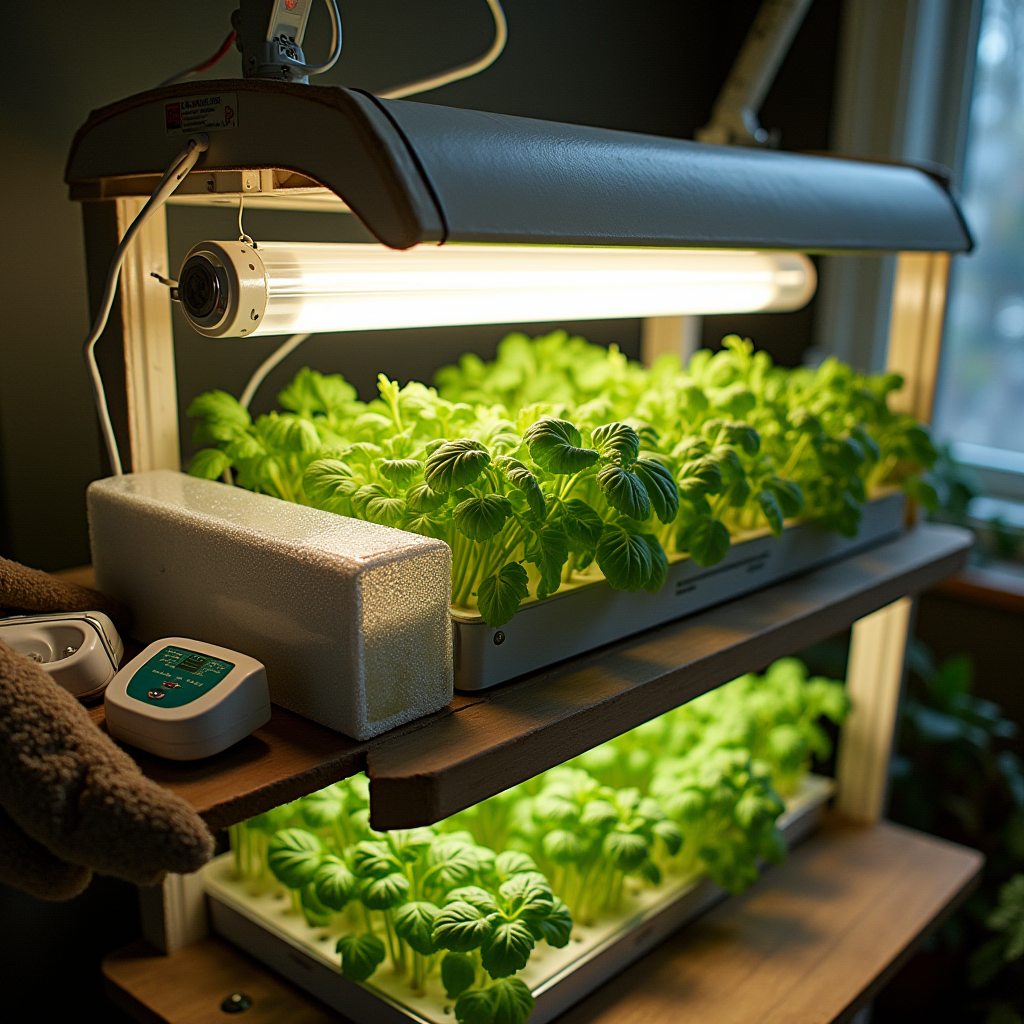
Fluorescent-to-LED in a hydroponic space is not the same as changing a kitchen lamp. In propagation racks and small grow rooms, light, heat, and wiring are part of a controlled system. The most common mistake is assuming you can drop any T5/T8 LED tube into old fixtures and carry on.
Symptoms of this mistake:
- Clones that wilt or bleach because LED PPFD is double what the fluorescents delivered.
- Seedlings that stretch or stall because spectrum or intensity is too low.
- Random fixture failures because the old ballasts were never designed for LED tube loads.
1.2 Ignoring tube type (A/B/C) and ballast condition
Many commercial LED tubes are sold as “fluorescent replacements” without clearly explaining how they expect to be wired. In practice, you are dealing with three main categories:
- Type A (plug-and-play) – designed to run on existing fluorescent ballasts.
- Type B (ballast-bypass / direct-wire) – ballast removed or bypassed; tubes wired directly to mains.
- Type C (remote driver) – new external LED driver feeds the lamps; the ballast is removed.
There are also hybrids that can run as Type A or B. For horticulture, trying to limp along on 10–15-year-old ballasts (Type A) is a reliability trap. As noted in CBC’s coverage, LEDs are now “better in every way,” and the market is shifting to LED-based electronics, not preserving legacy ballasts.
1.3 Matching watts instead of PPFD and DLI
Fluorescent retrofits fail most often because growers match watts, not photons. A 54 W T5HO tube does not map cleanly to any specific LED wattage. What matters is photosynthetic photon flux density (PPFD) at the canopy and daily light integral (DLI) across the photoperiod.
Under LEDs you can easily overshoot or undershoot. Clones that loved 80–120 μmol/m²/s under old T5s may get hammered by 250+ μmol/m²/s if you throw in high-output LED tubes at the same height.
1.4 No wiring verification or CSA/UL check
Another frequent mistake: having a “handy” staff member rewire fixtures without checking the LED tube’s installation manual, CSA/cUL listings, or the Canadian Electrical Code (CEC). Result:
- Single-ended tubes powered from both ends, creating shock hazards.
- Mis-matched lampholders (shunted vs non-shunted) with direct-wire tubes.
- Fixtures that no longer comply with their listing and could fail an inspection or an insurance claim.
1.5 Forgetting about heat and humidity balance
Fluorescents dump more heat than LEDs for the same light output. CBC’s piece highlights how incandescent lamps waste over 90% of electricity as heat, with fluorescents better but still inefficient, and LEDs now the most efficient mainstream source [source]. When you pull out banks of T5/T8s, you drop a chunk of “free” radiant and convective heat. If you do not adjust HVAC and dehumidification, you can end up with:
- Cooler reservoirs and slower nutrient uptake in Kratky and DWC.
- Higher relative humidity because surfaces are cooler.
- Condensation and disease risk around propagation benches.
1.6 Treating mercury tubes as regular trash
Canada’s policy shift is explicitly about mercury. CBC notes that a typical 13 W CFL contains around 3.5 mg of mercury and that the risk is about long-term environmental accumulation, not just one broken bulb [source]. Large hydroponic facilities with drums of spent T5/T8s dumping them into general waste are building a regulatory and environmental liability.
2. Why these mistakes happen (and how the new regulations push you to fix them)
2.1 Regulatory pressure plus supply-chain uncertainty
Environment and Climate Change Canada has already cut off new imports and manufacturing of CFLs, and the federal stance is clearly that mercury lamps are on the way out as LED options expand [source]. That creates a perfect storm for growers who kept fluorescents going because tubes were cheap and familiar:
- T5/T8 stock gets inconsistent or more expensive.
- Fixture manufacturers stop supporting older ballast models.
- Growers rush to buy “any LED tube that fits.”
The result is rushed decisions instead of a designed retrofit.
2.2 Legacy ballast mindset
For a long time, “upgrade” meant swapping T12 for T8, or old magnetic ballasts for electronic ones. That mindset sticks. Many growers still think the ballast is the heart of the system and try to retain it at all costs.
But per the CBC reporting, in the last five years LED-based tubes that fit fluorescent sockets have become widely available and are expected to replace fluorescent technology itself [source]. In that context, clinging to ballasts keeps an obsolete failure point in a grow-critical system.
2.3 Lack of PPFD/DLI literacy in propagation areas
Commercial top-lighting decisions often involve PPFD and DLI calculations. Propagation benches and hobby racks usually do not. Most small hydroponic growers know “two 4-lamp T5 fixtures per shelf” works, but few have ever mapped PPFD across the tray.
When you move to LEDs with much higher efficacy (μmol/J), that casual approach breaks. Double the photons on delicate tissue and you get photobleaching, not faster rooting.
2.4 Underestimating how much heat fluorescents add
In a tight indoor space, T5/T8s are mini space heaters. CBC’s analysis of lighting technologies shows how older sources waste a large share of energy as heat while LEDs push more of it into light [source]. In practice, your grow room is a balance between:
- Lighting heat.
- HVAC capacity.
- Transpiration and dehumidification load.
Strip out fluorescents without rebalancing, and your nutrient temperatures, VPD, and even CO₂ effectiveness change.
2.5 Poor understanding of lamp recycling obligations
Growers are busy running systems. It is easy to miss the fine print about mercury products. But federal guidance is explicit: fluorescent lamps should go to designated collection and recycling sites (depots, hazardous waste events, or approved return-to-retail programs) to keep mercury out of the environment [source]. If you are running a greenhouse or indoor farm, you are handling far more lamps than a typical household, which changes your risk profile.

3. How to fix your retrofit plan (step-by-step)
3.1 Decide: LED tubes vs new fixtures
First choice: keep your existing housings and retrofit tubes, or replace with purpose-built LED grow fixtures.
When LED tubes (T5/T8) make sense
- You have a lot of intact, corrosion-free strip fixtures or troffers above benches.
- Ceiling height is low and you need slim form factor over NFT channels, Kratky tanks, or DWC tubs.
- Budget is tight but you still want to cut power and eliminate ballasts.
When new LED grow fixtures are the better move
- Your fixtures are rusty or yellowed from high humidity and nutrient aerosols.
- You want higher PPE and full control (dimming, spectrum, remote drivers).
- Room layout is changing anyway (new racks, different crop mix).
If your fluorescent infrastructure is more than 10–12 years old, a clean replacement with modern LED bars is often cheaper in downtime and labour than nursing old housings along.
3.2 Choose the right LED tube type (A/B/C) for horticulture
For most hydroponic propagation and veg spaces, the sweet spot is usually:
- Type B (ballast-bypass) tubes for simple racks and rooms.
- Type C (remote driver) if you want centralized drivers, dimming, or integration with controls.
Type A (plug-and-play) can work as a temporary measure but keeps you dependent on ballasts that will fail and are increasingly unsupported. The long-term trend, as highlighted by lighting experts in the CBC article, is toward LED-centric electronics with better efficiency and lifespan [source].
Checklist for tube selection:
- Confirm voltage (120/277/347 V) compatibility with your building.
- Check CSA/cUL/ETL marks specifically for the tube model.
- Verify wiring scheme: single-ended vs double-ended power.
- Look for damp/wet-location rating if your grow area is humid.
- For propagation: favour 4000–5000 K “neutral” spectrum or full-spectrum horticultural tubes.
3.3 Safe ballast-bypass wiring: practical playbook
Always de-energize the circuit, lock it out, and verify with a meter before touching anything. The following is a practical overview; you must follow the tube manufacturer’s wiring diagram and CEC requirements.
Single-ended power tubes
- Use non-shunted lampholders on the powered end.
- Tie both pins on that end together if required by the diagram.
- Bring line (hot) and neutral to that same end; cap the opposite end’s wiring if present.
- Remove the ballast or isolate it completely; it should not remain in series.
Double-ended power tubes
- Connect line (hot) to one end’s lampholders, neutral to the opposite end.
- Ensure both pins on a given end are tied together if specified.
- Again, remove or fully bypass the ballast so mains power is coming directly from the supply.
After wiring:
- Install a clear label inside the fixture and at the branch circuit indicating “LED retrofit – direct wire, no ballast, line voltage at lampholders.”
- Test polarity if required by the tube (many single-ended tubes must be oriented correctly).
- Document which fixtures are now LED-only to avoid future fluorescent re-lamping attempts.
3.4 Hitting PPFD and DLI targets for hydroponic crops
Once the hardware is in, you must prove the light environment. Use a quantum PAR meter (even a rented one) to map PPFD at canopy height across representative trays.
Seedlings and early veg (Kratky, DWC, NFT)
- PPFD: 100–200 μmol/m²/s for germination and very young seedlings.
- PPFD: 200–300 μmol/m²/s for robust seedlings and early veg.
- Photoperiod: 16–18 hours/day.
Example DLI calculations:
- 150 μmol/m²/s × 16 h ≈ 8.6 mol/m²/day.
- 250 μmol/m²/s × 18 h ≈ 16.2 mol/m²/day.
Most leafy greens, herbs, and brassica seedlings are happy in the 8–15 mol/m²/day range during propagation and early veg.
Clones / cuttings
- PPFD: 50–150 μmol/m²/s at canopy during rooting.
- DLI: roughly 4–8 mol/m²/day, often with 18–24 hour photoperiods at the lower PPFD end.
Start clones on the low side (around 50–80 μmol/m²/s) and ramp up as roots develop. LEDs hit these numbers easily, so err on the side of caution and use height, dimmers, or fewer tubes if needed.
Microgreens
- PPFD: 150–300 μmol/m²/s depending on species and desired morphology.
- DLI: 10–17 mol/m²/day with 14–18 hour photoperiods.
Under LEDs, microgreens often come out stockier and more intensely coloured at similar or slightly higher DLIs than under T5s, but watch for heat build-up close to the diodes.
3.5 Adjusting photoperiod and HVAC after the swap
After retrofitting, do not assume your old schedules still make sense.
- Photoperiod: If PPFD has gone up, you can either shorten the day length to maintain similar DLI or keep the same day length and accept faster growth (with matching nutrient and CO₂ support).
- Heat: Monitor air and nutrient temperatures for at least a week. LEDs usually reduce radiant heat, so reservoirs in Kratky and DWC may run cooler. If solution temperature drops below about 18 °C for leafy crops, consider insulating or gently heating the nutrient zone.
- Humidity: Watch RH and VPD. Cooler surfaces and similar transpiration can push you into a more humid regime, especially in sealed rooms. You may need to tweak dehumidifier settings or add a small amount of background heat.
3.6 Nutrient, EC, and pH tuning under brighter LEDs
Higher PPFD usually drives faster growth and higher transpiration. In hydroponic systems:
- EC: You may be able to run slightly higher EC within crop-specific limits (e.g. move lettuce from 1.0–1.2 to 1.3–1.5 mS/cm) to feed increased demand, but watch carefully for tip burn in fast-growing leaves, especially in static Kratky setups.
- pH: Aggressive growth often nudges pH upward. Aim to keep most leafy greens and herbs at pH 5.8–6.3. With stronger light, daily pH checks are wise until you understand the new drift pattern.
- Reservoir temperature: The LED swap may lower solution temperature, which is good for dissolved oxygen but can slow cold-sensitive crops. Keep most systems between about 18–22 °C.

4. What to watch long-term: safety, compliance, and mercury cleanup
4.1 Verifying CSA/UL compliance after modifications
Any time you change how mains power flows through a listed fixture, you have to think about compliance. Good practice:
- Use only LED tubes that are CSA, cULus, or ETL listed for direct-wire applications.
- Use lampholders and wiring components with equal or higher voltage and temperature ratings than the originals.
- Follow the retrofit instructions provided by the LED manufacturer. Many list specific wiring options that preserve listing when done as directed.
- Document what was changed and keep product datasheets on file for inspectors or insurers.
4.2 Mercury lamp handling and disposal SOPs
CBC’s reporting notes that mercury in fluorescent lamps is sealed, but the bigger issue is long-term leaching from improperly discarded bulbs and the bioaccumulation of mercury in ecosystems and food chains [source]. For a hydroponic farm, build a simple standard operating procedure.
Collection and storage
- Designate a labeled, closed container or drum for spent tubes near your electrical workshop, not in the grow room.
- Do not tape bulbs together or crush them on-site; broken glass increases exposure and complicates recycling.
- Train staff to set aside any broken lamp fragments for separate handling.
Breakage response
- Ventilate the area if a lamp breaks, especially in small rooms.
- Use stiff paper or cardboard to scoop glass and phosphor powder; avoid vacuuming unless using equipment rated for this purpose.
- Place debris into a sealed bag or container and add it to your lamp recycling stream.
Recycling and documentation
- Use municipal hazardous waste events, designated depots, or return-to-retail programs, as recommended by Environment and Climate Change Canada [source].
- For large operations, contract a lamp recycling company that provides approved containers and manifests (similar to the Dan-X Recycling setup highlighted by CBC).
- Keep basic records of quantities recycled each year; this is useful for audits and sustainability reporting.
4.3 Planning future expansions around LEDs, not fluorescents
The LED transition is not a one-off event; it sets the baseline for your next decade of infrastructure. Because, as the CBC article points out, LEDs keep getting cheaper and more efficient over time [source], your next expansion should assume:
- No new fluorescent capacity.
- Centralized, dimmable LED lighting with PPE data available.
- Integrated controls tying light levels to time of day, crop stage, and, in larger facilities, real-time energy pricing.
4.4 Monitoring plant response as the final “inspection”
Even if your wiring is perfect and your PAR meter says the numbers are right, the plants are still the final inspectors. For the first 2–4 weeks after conversion:
- Track rooting speed and strike rates in cloners and propagation trays.
- Watch for leaf edge scorch, interveinal chlorosis, and unusual morphology (excessively tight internodes can indicate overly intense light for some crops).
- Log EC, pH, and solution temperature daily and compare to pre-retrofit baselines.
Adjust light height and photoperiod in small increments. In DWC and Kratky systems, where water volume and buffering are high, you have some margin, but the closer you are to crop limits, the more value there is in careful tuning.

Wrapping it up: turning a ban into an upgrade
Canada’s ban on compact fluorescents and the broader move away from mercury lamps is not an abstract policy change for growers. It is the nudge to retire aging T5/T8 infrastructure, remove ballasts from the failure tree, and move to a lighting platform that is more efficient, dimmable, spectrum-tunable, and mercury-free.
If you treat this as a system design project rather than a bulb swap, you can come out ahead on every front: lower kWh per mol of light, more controllable PPFD/DLI for seedlings, clones, and microgreens, cleaner wiring that passes inspection, and a clear plan for getting toxic legacy lamps out of your building responsibly. The phase-out is coming either way; the goal is to make sure your next harvest is stronger because of it.
As an Amazon Associate, I earn from qualifying purchases.