How to Grow Microgreens for Maximum Nutrient Density Indoors (2026): Species, LED Spectrum, Harvest Age, and Claim Compliance
Common Mistakes: Why Most “Nutrient-Dense” Microgreens Are Just Fast Greens
Most indoor microgreen operations focus on speed and yield per tray. If you are chasing maximum nutrient density, that approach quietly works against you.
The new wave of coverage around a 2026 review pointing out that some microgreens can reach 4–40x the nutrient levels of mature vegetables, with harvests in as little as 10–12 days, sounds like free money for indoor growers. But very few growers actually hit anything close to those numbers, and even fewer can prove it or write a compliant label.
The most common mistakes I see when people try to grow “supercharged” microgreens indoors are:
- Picking random species instead of those with proven high vitamin and antioxidant potential.
- Running generic LED settings that push biomass, not phytonutrients.
- Harvesting “whenever they look big enough” instead of targeting species-specific nutrient peaks.
- Treating nutrients like a houseplant feed, with no real pH/EC control.
- Talking about health benefits without any lab data or FDA/FTC-safe wording.
This article is a correction to that. It is a practical, grower-first playbook for how to grow microgreens for maximum nutrient density indoors, and how to talk about that nutrition without tripping over labeling rules.
At the core we are going to tune five things:
- Species and cultivar choice.
- LED spectrum and DLI.
- Harvest timing by species (roughly 8–14 days, not blindly “day 10”).
- Hydroponic/Kratky solution management (pH, EC, substrate).
- Postharvest handling and a simple validation/labeling workflow.
The recent review highlighted by this report lines up with earlier work showing that, under the right conditions, microgreens can concentrate vitamin C, carotenoids, and phenolic antioxidants far above their mature versions. The gap between that potential and your trays comes down to avoidable mistakes.
Why These Mistakes Happen (And What the Plant Physiology Says)
Most of the mistakes above come from treating microgreens like baby lettuce instead of what they are: seedlings running hot on internal fuel. At this stage, the seed’s reserves are driving rapid development. If light and mineral nutrition are in the right band, you get compact plants with high concentrations of vitamins, pigments, and antioxidants per gram. If they are off, you still get a tray of greens, but the lab numbers stall.
Mistake 1: Random Species, No Nutrient Strategy
Not all microgreens are equal. Some are aesthetic fillers; others are nutritional heavyweights. Ignoring this is the first leak in your system.
From controlled-environment studies and industry experience, the consistent nutrient-dense performers tend to be:
- Brassicas: red cabbage, broccoli, kale, mustard, mizuna. High vitamin C, carotenoids, vitamin K, and glucosinolates.
- Color-heavy species: red amaranth, beet, purple or red radish. Rich in betalains, anthocyanins, and phenolic antioxidants.
- Herbs: cilantro, parsley, basil. Strong phenolic content and vitamin C, but slightly longer cycles.
- Larger-seeded types: sunflower, peas. Useful for vitamin E, some healthy fats, and texture.
When reviews talk about “up to 40x” nutrient levels, they are usually referring to specific brassicas grown under controlled light and nutrient regimes, not a random generic mix.
Mistake 2: Lighting for Fast Biomass, Not Phytonutrients
Many growers hang a bright LED, set a long photoperiod, and call it done. That may grow volume fast, but you are leaving antioxidant and pigment production to chance.
Two variables matter most:
- Spectrum (blue:red balance, plus overall full spectrum)
- DLI (total photons per day), not just brightness at one moment
Blue-heavy portions of a full-spectrum LED tend to encourage compact growth and higher secondary metabolites in leafy crops, including microgreens. A DLI around 12–18 mol m⁻² d⁻¹ is often the sweet spot for microgreens: enough energy to build dense tissue and color without heat stress.
Mistake 3: Guessing Harvest Day Instead of Targeting a Window
The “10–12 day microgreen” line floating around comes from a real pattern but gets used like a rule of thumb. In reality:
- Radish, broccoli, mustard, and cabbage can hit a nutrient-rich stage in about 8–12 days under warm, high-light indoor conditions.
- Pea and sunflower can lean toward 10–14 days.
- Herbs like cilantro and parsley often do better around 14–21 days.
Within that, specific compounds peak at different times. Vitamin C often peaks early, pigments and some phenolics build with light exposure, and glucosinolates can be highest at a true microgreen or early baby-leaf stage. Harvesting purely “when it looks full” ignores these curves.
Mistake 4: Weak Nutrient Management, No pH/EC Targets
Microgreens are short-cycle, but that is not an excuse to ignore solution chemistry. Running tap water plus a splash of fertilizer can still yield nice-looking greens that underperform nutritionally and are inconsistent between batches.
The seed provides a buffer, but key minerals (especially calcium, magnesium, iron, and micronutrients) plus nitrogen balance still shape tissue quality and vitamin content. Running too high EC introduces salt stress that reduces quality. Running too low EC limits growth and dilutes nutrient potential per tray-day.
Mistake 5: Aggressive Health Claims Without Data
Quoting “40x more nutrients than mature vegetables” on a label without backing is inviting problems. In the U.S., nutrient and health claims are regulated by the FDA and FTC. Any specific nutrient content claim (for example, “excellent source of vitamin C”) needs to be backed up by either recognized food-composition data or your own lab analysis, and it must meet specific %DV thresholds per serving as set in FDA rules.
That does not mean you cannot talk about nutrition. It means you must do it carefully, and with evidence.
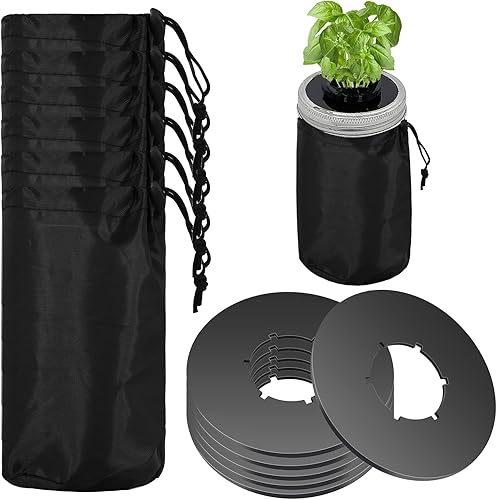
How to Fix Them: A Nutrition-First Microgreen Blueprint
Fixing these mistakes is not complicated. It is about running your microgreens like a small, controlled-environment production system instead of a side project.
1. Build a Species Portfolio Around Proven Nutrient Density
For maximum nutritional value, think in terms of categories rather than single “superfoods.” A balanced, nutrient-dense offering might look like this:
- Brassica core (40–50%): broccoli, red cabbage, red or green kale, mustard, mizuna. These give you vitamin C, K, carotenoids, and glucosinolates. Many studies showing the “multiple of mature veg” effect are centered on this group.
- Color and antioxidant boosters (20–30%): red amaranth, beet, purple radish. Their intense pigments are linked to betalains and anthocyanins with strong antioxidant capacity.
- Flavor and phenolic herbs (10–20%): cilantro, parsley, basil. They improve flavor and contribute phenolics and vitamin C.
- Texture and vitamin E (10–20%): sunflower and pea shoots. These round out mouthfeel and add tocopherols.
Instead of claiming one tray is everything, you offer a line-up where each species or mix has a clear nutritional angle. For example: “Brassica Boost Mix” (broccoli + red cabbage + kale) or “Antioxidant Color Mix” (amaranth + beet + purple radish).
2. Lock In LED Spectrum & DLI For Nutrient-Dense Growth
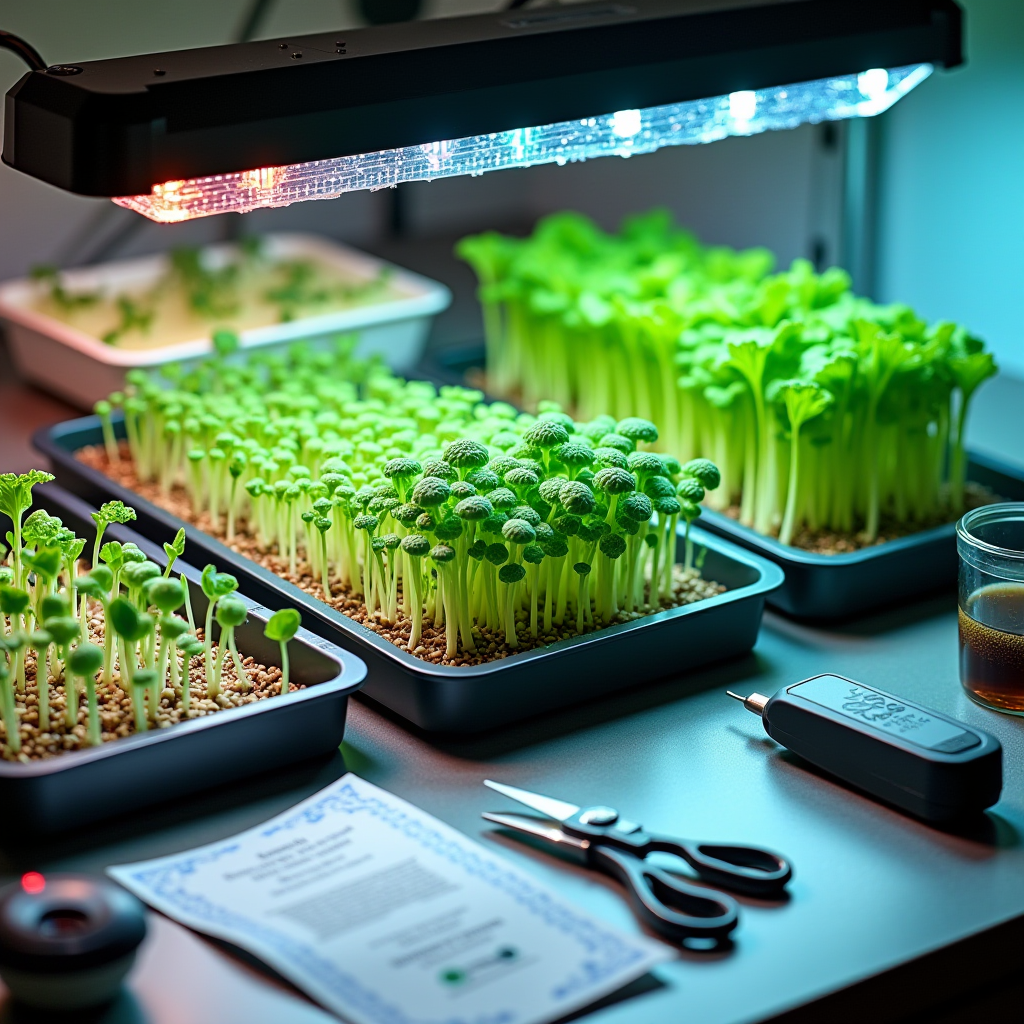
Your light strategy should be explicit, not guessed. For indoor microgreens, a robust baseline configuration looks like this:
- Spectrum: full-spectrum white LED around 4000–5000 K with a noticeable blue component. Avoid extreme “pink” fixtures unless you know their spectral output.
- PPFD at canopy: roughly 150–300 µmol m⁻² s⁻¹, measured at plant height.
- Photoperiod: 14–16 hours on, 8–10 hours off.
That yields a DLI of around 12–18 mol m⁻² d⁻¹, right in the target range for compact, nutrient-dense microgreens. Lower PPFD (150–200) works well for delicate herbs; 200–300 favors brassicas when you want intense color and high dry matter.
If your fixture does not have a spectrum chart, favor high-CRI (≥90) full-spectrum “grow” or shop lights designed for plants. They usually deliver enough blue to support phytonutrient formation in microgreens.
3. Use Kratky-Style Hydroponics With Actual Targets
Kratky and shallow passive systems are ideal for microgreens: short cycle, no pumps, and easy to standardize. To make them nutrition-first instead of “just wet roots,” set real targets.
Substrate
- Hemp, jute, or biostrate mats are clean and compostable.
- Thin coco coir layers or rockwool sheets also work but need more careful handling.
The substrate’s job is simple: anchor seeds and wick nutrient solution. It is not there to contribute nutrition.
Nutrient solution
- Formula: a balanced hydroponic nutrient for leafy greens.
- EC: 0.8–1.2 mS/cm for most microgreens; up to about 1.6 for brassicas if you have experience and good airflow.
- pH: 5.8–6.2 is ideal for availability of most minerals in inert media.
Mix in a clean reservoir, then add enough solution to your tray so the mat or substrate is evenly moist and the bottom can keep wicking. In Kratky trays, allow the level to slowly drop as plants drink, which creates a moist-to-air gradient for the roots.
Environment
- Air temperature: 18–24°C (64–75°F).
- Relative humidity: 40–60% if you have some control.
- Airflow: gentle but continuous to reduce mold and strengthen stems.
This combination keeps stress within a range that encourages nutrient and pigment accumulation without hammering yield.
4. Dial In Harvest Windows By Species, Not A Single Day Count
Ignore a universal “day 10” rule. Instead, define harvest windows per species under your exact conditions (light level, temperature, moisture). A practical starting benchmark is:
- Radish, broccoli, mustard, kale, cabbage: 8–12 days from sowing. Harvest when cotyledons are fully open and first true leaves are just visible.
- Pea and sunflower: 10–14 days. Harvest when shoots are 7–12 cm tall and still tender.
- Cilantro, parsley, basil: 14–21 days. Harvest when plants are sturdy, with vibrant color and early true leaves.
Within each window, do small staggered trials. Harvest half a tray a day or two earlier, half a day or two later. Track color, texture, and yield, and (if you are serious) send a couple of time points to a lab. You will quickly see where your real-world nutrient peak falls.

What to Watch Long-Term: Quality Control, Postharvest, and Claim Compliance
Once your trays look the part, the long-term game is keeping every harvest consistent and keeping your marketing honest. That means tight handling, simple QA routines, and a basic understanding of FDA nutrition labeling.
Postharvest Handling To Preserve Vitamins & Antioxidants
Most vitamins and antioxidants are sensitive to heat, oxygen, and mechanical damage. You do not need a giant cold room, but you do need a clean, fast process.
Step-by-step postharvest workflow
- Sanitation first: clean shears or knives, sanitized trays and surfaces.
- Cut above the medium: avoid dragging blades through substrate to reduce contamination.
- Optional quick rinse: if you rinse, use cold, clean water, gentle agitation, and get greens dry quickly using a salad spinner or clean towel.
- Rapid cooling: move harvested microgreens into a refrigerator at roughly 1–4°C (34–39°F) as soon as surface moisture is off.
- Packing: use breathable clamshells or bags designed for fresh produce to balance moisture retention and gas exchange.
Every hour that cut microgreens sit warm on a bench is time for vitamin C and other sensitive compounds to degrade. Treat them like you would delicate greens in a professional kitchen.
A Simple Nutrient Validation Workflow
If your brand hinges on “nutrient-dense microgreens,” invest in a minimal but disciplined validation process rather than relying on generic numbers.
1. Standardize your grow recipe
- Document seed source, seeding rate per tray, substrate type, nutrient formula, EC and pH at mix, light height and schedule, and harvest age.
- Run at least several batches under the same recipe to make sure results are stable.
2. Send representative samples to an accredited lab
- Choose your key SKUs: for example, “Broccoli Microgreens,” “Brassica Boost Mix,” and “Antioxidant Color Mix.”
- Harvest typical product, pack as you would for sale, chill, and ship overnight with cold packs.
- Request analysis for macronutrients and the vitamins/minerals you care about (often vitamin C, K, E, folate, plus maybe carotenoids).
Labs can often format results specifically for nutrition labeling, which simplifies the next step.
3. Build your Nutrition Facts panel correctly
In the U.S., most packaged food needs a Nutrition Facts panel unless you fall under specific exemptions for very small businesses and certain direct-to-consumer situations. Even if exempt, once you make specific nutrient content claims, you are expected to have supporting data and, in many cases, proper labeling.
Key points for nutrition panels, based on FDA guidance:
- Serving size should be realistic (for example, 28 g / 1 oz), based on how people actually use microgreens.
- % Daily Value (%DV) must be calculated using FDA reference DVs.
- To claim “good source” of a nutrient, one serving must provide 10–19% of the DV; “high in” or “excellent source” means at least 20% DV per serving.
- Keep records of lab reports and any calculations linking them to the panel.
If you are using published database values instead of lab tests, make sure the entries match your product closely (species, stage, raw vs cooked). Be honest about how approximate those numbers are, and be ready to adjust if you change your grow recipe in ways that could move nutrient levels.
Claim Language That Stays on the Right Side of FDA/FTC Rules
There is a big difference between saying “microgreens can have higher levels of certain vitamins compared with mature vegetables, according to published research” and printing “40x the nutrients of vegetables” on your label.
Safer, evidence-based approaches include:
- Using language like “rich in” or “contains vitamin C and vitamin K” without making specific comparative or disease-related claims, unless your lab data and legal advice back it up.
- Referencing research in general terms on your website or marketing materials, with links to sources, instead of making absolute, quantified comparisons on the package.
- Sticking to structure/function style phrases (“supports a varied diet rich in vegetables and herbs”) rather than disease claims (“prevents cancer”).
For any high-stakes claim, it is worth having a food-law professional review your labels once you have your lab data. The cost is tiny compared with a recall or enforcement headache.
Light, Nutrient, and Harvest Benchmarks To Track Over Time
To keep your “maximum nutrient density” promise season after season, track a few simple metrics:
- Light: PPFD and photoperiod per shelf or rack. Recheck when you change fixtures or raise/lower lights.
- Solution chemistry: EC and pH at mix and mid-cycle for each batch.
- Harvest metrics: days from sowing, average tray yield, and visual notes (color intensity, stem length).
- Lab checks: retest key SKUs when you change seed lot, nutrient brand, LED spectrum, or harvest timing, or at least annually.
Those simple records transform your microgreens from a nice-looking product into a controlled, repeatable nutrition product you can stand behind.
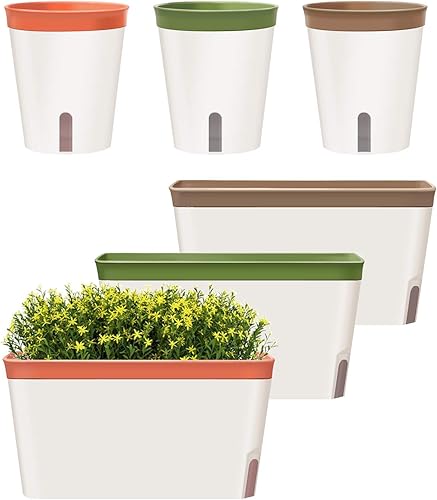
Putting It All Together
When you strip out the hype, growing microgreens for maximum nutrient density indoors boils down to a few disciplined choices:
- Choose species with known high vitamin and antioxidant potential, especially brassicas and pigmented types.
- Run full-spectrum LEDs with enough blue, at a DLI around 12–18 mol m⁻² d⁻¹, to fuel compact, pigmented growth.
- Use a Kratky-style hydroponic setup with set pH (5.8–6.2) and EC (around 0.8–1.2 mS/cm) rather than guessing.
- Harvest by species-specific visual and time cues, not a single date on the calendar.
- Cool and pack fast to lock in vitamins and antioxidants.
- Back your nutrition story with lab data and label it in line with FDA rules.
If you implement that stack, you are not just selling “microgreens.” You are running a tight indoor nutrition crop with numbers you can actually defend.
As an Amazon Associate, I earn from qualifying purchases.