Hydroponic Strawberries in Polytunnels (2026 Guide): Coco/Perlite Gutters, EC/pH Recipes, Drip Layouts, and Runoff Compliance
Most field teams think switching to substrate gutters is just “putting bags of coco in a tunnel and adding drippers.” In 2026, that mindset is how you end up with soft fruit, blocked drains, and an inspector asking where your nitrate-laden runoff is going.
This guide walks you through a commercial-grade, polytunnel-ready strawberry system in coco/perlite: gutter layout, emitter spacing and flow, EC/pH targets, leachate percentage, and how to capture and treat runoff so you can pass water and pollution audits without sacrificing yield.
1. Common Mistakes In Polytunnel Strawberry Substrate Systems
1.1 Treating polytunnel hydro like upgraded field drip
The first mistake is assuming polytunnel substrate is just field drip irrigation under plastic. That thinking ignores root-zone EC, substrate saturation, and the fact that every liter of drain is now a concentrated fertilizer waste stream that regulators care about.
Right now, job boards are full of ads for “hydroponics supervisors”, “controlled-environment berry leads”, and “fertigation technicians” in traditional growing regions as operations convert to covered, substrate production (see hydroponic job listings). The reason is simple: substrate hydroponics behaves very differently from soil, and you need to manage it accordingly.
1.2 Sloppy gutter and drainage design
The second big failure point is water management hardware. Many retrofits throw coco bags into flimsy gutters with almost no slope and ad‑hoc drain connections. The result: standing leachate, algae mats, salt accumulation around drain points, and inconsistent moisture along the row.
On top of that, tunnels are often retrofitted with no clear drainage path to a sump, and no plan for what happens to 10–20% leachate on a hot day. In cities where “smart irrigation” programs are being rolled out to save water and curb nutrient pollution, poor drainage management is exactly what gets you flagged (example: NDMC’s smart irrigation push in Delhi).
1.3 Guessing at EC, pH, and leachate instead of targeting them
Strawberries in coco do not tolerate lazy fertigation. Running “whatever the tomatoes use” at 2.5–3.0 mS/cm with no runoff monitoring is a fast track to salt stress, tip burn, and weak fruit.
The same goes for pH: if your feed wanders between 5.0 and 6.8 depending on who mixed the tank, your Ca and micronutrient uptake will wander with it. Over a 6–9 month crop, that shows up as blossom end issues, uneven truss development, and higher Botrytis pressure.
1.4 No runoff capture or compliance plan
As water and pollution regulations tighten, “drain to the hedgerow” is no longer a plan. Smart agriculture investments are growing globally precisely because authorities and retailers want traceable, efficient water and nutrient use (see smart agriculture market analysis).
Polytunnel berry farms are in the crosshairs. Regulators and buyers are increasingly asking how you capture, measure, and either treat or beneficially reuse nutrient-rich runoff. If you cannot show that, you are behind the curve.

2. Why These Mistakes Happen (And The Real Constraints In 2026)
2.1 Labor and skills are shifting faster than infrastructure
Hydroponic polytunnels are expanding faster than skilled fertigation staff. Recruitment data shows increasing demand for hydroponic and controlled-environment roles in otherwise traditional growing regions (see job trends). In many operations, tunnels get converted before there is a proper hydro lead in place.
That mismatch leads to “field irrigation logic” being applied to substrate systems: longer cycles instead of more frequent pulses, EC set by feel, pH checked when there is a problem instead of proactively.
2.2 Regulatory lag is closing
For years, substrate berries could hide behind “we’re using less water than open field” and avoid detailed runoff controls. That window is closing. Municipalities are deploying smart irrigation and monitoring to save water and track pollution (example from Delhi), and specialty crop reporting is highlighting water and nutrient issues more often (see produce sector news).
Once a regulator or buyer realizes that your gutters are dumping concentrated nitrate and phosphate into surface drains, you can expect pressure to install sumps, flow meters, and treatment or reuse capacity.
2.3 Recirculation is attractive, but technically unforgiving
Closed-loop fertigation looks like the obvious sustainability play: less water, lower fertilizer costs, greener story. The catch is ion balance, pathogen risk, and sensor reliability. Without UV or equivalent disinfection, one diseased block can seed your entire farm’s root zone. Without regular lab analysis and recipe adjustment, Na and Cl creep up while Ca and micronutrients drift.
Many growers know they should be recirculating but lack the capital or expertise to do it safely. So they sit in a half-step: improvised drain capture that is not yet a clean reuse system, but also not fully compliant drain-to-waste.
2.4 Strawberry physiology is unforgiving of poor root-zone control
Strawberries are not lettuce. They run a long crop cycle, are sensitive to salinity, demand steady Ca and B for fruit quality, and hate waterlogged roots at low temperatures. A sloppy fertigation regime can limp through a leafy greens cycle; strawberries will punish you with uneven trusses, soft berries, and Botrytis-prone canopies.

3. How To Fix Them: Practical Polytunnel Design And Recipes
3.1 System choice: drain to waste vs recirculating in polytunnels
3.1.1 Drain-to-waste (DTW) with full runoff capture
For most teams retrofitting polytunnels between now and 2026, a well-designed DTW system with runoff capture is the most robust starting point.
- Pros: Stable chemistry, simple to manage, limited pathogen spread, easy to troubleshoot.
- Cons: Requires proper runoff collection, storage, and either reuse on non-food areas or compliant disposal.
Minimum spec for DTW with capture:
- All gutters sloped 1–2% toward header drains.
- Header drains connected to a lined central collection channel or pipe system.
- Capture tank or sump sized to at least 30–60 minutes of peak runoff flow.
- Ability to pump captured leachate to a buffer irrigation line (windbreaks, grass, non-edible crops) or on-farm treatment.
3.1.2 Recirculating with UV disinfection (2026-ready)
Once your team has EC/pH control and consistent leachate logging, you can shift part of your drainage into a recirculating loop.
- Install a filtration and UV train: coarse screen, sand or disc filter, then UV sized to your design flow and required dose.
- Blend treated leachate with fresh water and stock solution in the mixing tank (for example, 20–50% leachate, adjusted based on analysis).
- Track Na, Cl, and trace accumulation via periodic lab tests; adjust the fraction of recirculation accordingly.
3.2 Coco/perlite gutters and bag layout
3.2.1 Substrate recipe and bags
- Blend: 70–80% buffered coco with 20–30% perlite by volume gives a good balance of water-holding and drainage.
- Buffering: Use Ca/Mg-buffered coco; unbuffered material will tie up Ca and Mg in the first weeks.
- Bag size: 15–18 cm wide, 12–18 cm high, 0.8–1.0 m long slabs are standard for strawberries.
- Planting density: 4–6 plants per slab, with 8–12 plants per linear meter of gutter depending on cultivar and light.
3.2.2 Gutter specifications
- Material: Rigid UV-stable plastic or composite gutters with smooth interiors.
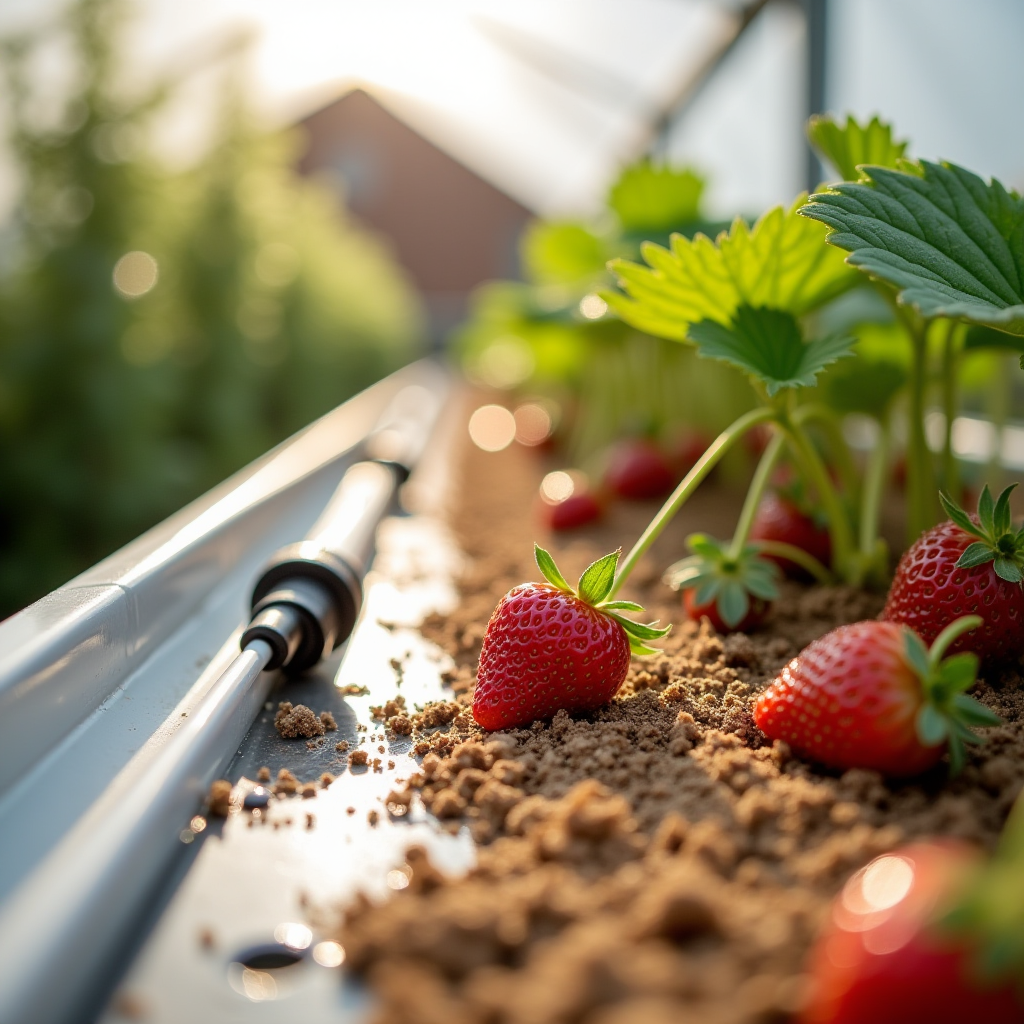
- Slope: 1–2% (1–2 cm drop per meter) towards the drain outlet.
- Support: Level supports every 1–2 m to prevent sagging that traps leachate.
- Drain holes in bags: 4–6 small slits along the lower edge aligned with the low side of the gutter; avoid punching large holes that over-dry the slab.
3.3 Drip emitter spacing, flow rate, and line design
3.3.1 Emitter density
- Use 1 emitter for every 2 plants as a baseline in coco/perlite.
- Example: 4 plants per slab = 2 emitters; 6 plants per slab = 3 emitters.
- On very hot or low-humidity sites, consider 1 emitter per plant in high-yielding cultivars to avoid dry pockets.
3.3.2 Flow rate and pressure
- Flow: 2 L/h pressure-compensating emitters are a solid standard for strawberries.
- Line pressure: Design for 1.0–1.5 bar at the farthest emitter, checking manufacturer specs.
- Flush valves: Install flush points at the end of each lateral to remove sediment and biofilm.
3.3.3 Irrigation frequency and leachate targets
- Target 10–20% leachate volume over the day under normal conditions.
- In high EC source water or very hot weather, you may push to 20–25% to prevent salt buildup.
- Run short pulses (for example, 1–3 minutes with 2 L/h drippers) many times per day rather than long soaks.

3.4 EC/pH recipes and fertigation for strawberries in coco
3.4.1 Feed and runoff setpoints
- Feed pH: 5.5–6.0.
- Feed EC: 1.5–1.8 mS/cm during establishment; 1.8–2.2 mS/cm under heavy flowering and fruiting.
- Runoff EC: roughly 0.2–0.5 mS/cm higher than feed (for example, feed 1.8, runoff 2.0–2.3).
- Runoff pH: 5.8–6.3. Persistent runoff above 6.5 usually signals recipe or buffering issues.
Measure feed and runoff EC/pH daily from the start, middle, and end of several lines. Log the data. You are looking for trends, not perfect single readings.
3.4.2 Macro and micro nutrient strategy
N and K: Aim for a solution N:K ratio of about 1:1.2–1.5 during heavy fruiting. Avoid overdoing N late in the crop to prevent soft, disease-prone fruit.
Ca, Mg, and K balance: Keep K:Ca:Mg in a ballpark molar ratio of 2–2.5 : 1 : 0.7–0.8. In practice, many commercial recipes land in the range of 100–150 ppm Ca, 40–60 ppm Mg, and an elevated K level appropriate for your target EC.
Calcium nitrate: Keep it in stock solution A, separate from sulfates and phosphates. Maintain steady Ca; do not rely on intermittent “Calcium booster” days.
Boron: Run a complete micronutrient mix that delivers around 0.3–0.5 ppm B. Strawberries need B for flowering but are intolerant of excess.
3.4.3 Example daily fertigation pattern
This is a pattern, not a prescription; adjust the number and length of events to your climate and substrate volume.
- First irrigation 30–60 minutes after light ramps up or tunnel sides open: short pulse to re-wet the upper root zone, no intentional drain.
- Multiple short pulses through the high-radiation period (for example, every 20–40 minutes at midday in hot, bright conditions).
- Final pulse 1–2 hours before sunset; avoid saturating coco late when tunnel temperatures and transpiration drop.
3.5 Botrytis control via nutrition and moisture management
Botrytis will never be solved with nutrients alone, but root-zone management can make your fungicide and biocontrol program work a lot harder for you.
- Keep EC moderate so plants are firm but not lush and floppy.
- Maintain adequate Ca and K to support firm berries and better stomatal control.
- Avoid large late-evening irrigation events that spike humidity in a cooling tunnel.
- Never use overhead irrigation in fruiting tunnels; keep foliage and flowers dry.
- Prune and space to keep air moving around flowers and fruit.

4. What To Watch Long-Term: Compliance, Data, And System Evolution
4.1 Runoff compliance and documentation
From an auditor’s perspective, a compliant polytunnel strawberry system needs more than good intentions. You should be able to show:
- How much water you apply (irrigation meter readings at the mainline).
- How much leachate you collect (meter or estimate at the sump discharge).
- Representative EC and pH of feed and runoff over time (a simple spreadsheet or controller logs).
- Where the captured runoff goes: recirculated via treatment, used on non-edible areas, or sent to a permitted treatment system.
Pair this with a basic maintenance log for your filtration and UV system (lamp changes, sleeve cleaning, filter backwashes). That record-keeping will become more important as smart-ag monitoring and reporting become standard in produce supply chains.
4.2 Sensor, probe, and system maintenance
- Calibrate EC and pH probes at least weekly in commercial operations.
- Check dripper uniformity each season by measuring output from a set of emitters along a line.
- Flush lines regularly, especially at season start and after any work on the mixing system.
- Inspect gutters for sagging and standing water after heavy irrigation and after workers have been in the tunnel.
4.3 Moving from drain-to-waste to recirculating
If you are starting out, design your infrastructure so you can tighten the loop later with minimal disruption:
- Install gutters, header drains, and sumps capable of handling all leachate.
- Allow space and plumbing for filters, UV, and a recirculation mixing tank even if you do not buy them on day one.
- Start by reusing treated runoff on non-edible crops or buffer strips to gain experience with treatment hardware.
- Once you trust your treatment and monitoring, gradually increase the recirculated fraction in your fertigation system while watching ion balance.
4.4 Why Kratky is not your commercial polytunnel solution
The Kratky method has its place in low-tech leafy greens and small-scale systems, but for polytunnel strawberries it is the wrong fit. Static reservoirs in warm tunnels struggle to maintain oxygen levels and stable EC/pH over a multi-month fruiting cycle. Pathogen buildup is also a major risk without active filtration and disinfection.
For commercial 2026 conditions, drip-fed coco/perlite gutters with captured drainage are the sweet spot: controllable, auditable, and capable of high, consistent yields.
4.5 Field-team checklist for ongoing performance
- Daily: Check pH/EC of feed and runoff, confirm leachate percentage, walk gutters for standing water.
- Weekly: Calibrate probes, verify dripper output on sample emitters, clean filters, inspect UV status.
- Monthly: Review runoff volume vs irrigation volume, check for drift in runoff EC/pH trends, adjust recipes or irrigation strategy.
- Per crop: Run at least one full tissue analysis to fine-tune Ca, K, Mg, and micronutrients.
Dial these basics in and your polytunnel strawberry system will not just produce; it will stand up to the next decade of smart-ag expectations, water scrutiny, and buyer audits.
As an Amazon Associate, I earn from qualifying purchases.