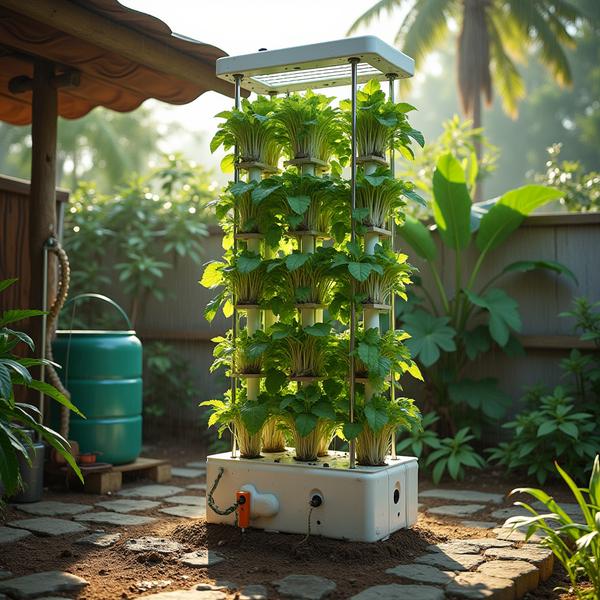
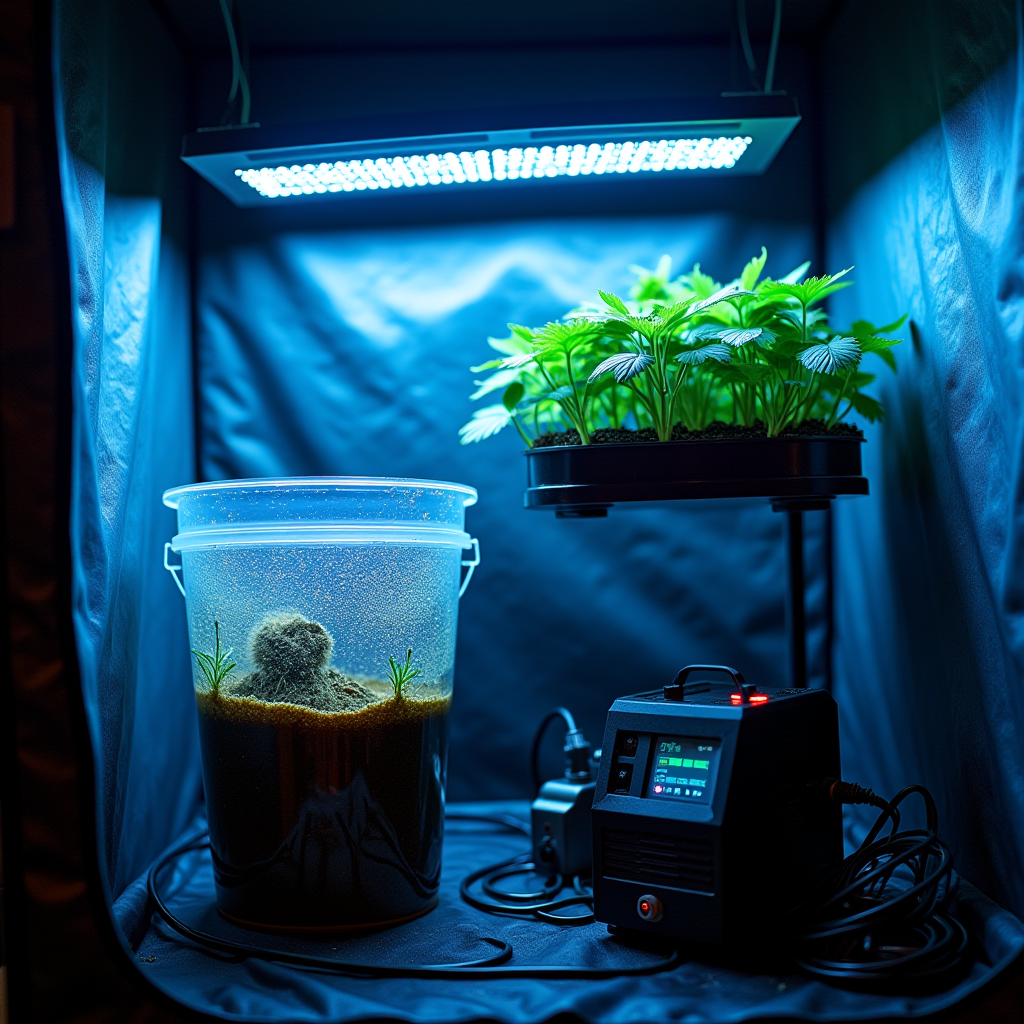
Hydroponics Backup Power That Actually Works: UPS and Portable Power Station Sizing for DWC & NFT
The Big Question: How Do You Keep DWC & NFT Alive When The Power Drops?
"A short outage won’t hurt anything." That belief quietly kills more DWC and NFT systems every storm season than pests and nutrients combined.
In Deep Water Culture and NFT, you are always a few bad minutes away from a dissolved oxygen crash. No pump, no bubbles, no flow. Roots go anaerobic, biofilms spike, and in aquaponic hybrids your fish are choking at the same time.
This article is a practical blueprint to size real backup power for grid-tied hydroponic systems. We’ll keep it focused on what actually matters:
- Measuring your DWC/NFT loads correctly
- Prioritising aeration over everything else
- Choosing pure-sine UPS vs portable power stations
- Calculating realistic runtime (Wh vs pump draw)
- Setting up automatic transfer and testing drills
This is not a full off-grid or solar design. This is about surviving 30 minutes to 12 hours without losing a crop.
What’s Really Going On: Why DWC & NFT Are So Vulnerable To Outages
Dissolved Oxygen: Your Real Critical Load
In DWC and NFT, oxygen is life support. Air pumps, airstones, and water movement are what keep dissolved oxygen (DO) in the safe range.
Airstones (bubble stones) increase the gas exchange area and help keep the solution mixed, as explained in this overview of bubble stones. Without that agitation, roots quickly strip oxygen from still water.
- DWC: Roots are fully submerged. Lose aeration and DO can fall sharply in 30–60 minutes, especially in warm, mature systems with dense roots.
- NFT: Roots depend on a thin moving film of nutrient solution plus access to air. Lose pump flow and roots can dry or suffocate, depending on humidity and system design.
- Aquaponic hybrids: Fish demand oxygen too. DO crashes hit fish even faster than plants.
Kratky growers can relax a bit here: the method is passive and designed with an air gap, so backup power is far less critical compared with actively bubbled DWC, as noted in many starter kits like the DWC-focused hardware from Aquifarm.
Storm Seasons, Aging Grids, And Why "Brief" Isn’t Safe Anymore
Grids in many regions now fail in more annoying patterns: repeated short cuts, brownouts, and multi-hour rolling outages. For hydroponics, that means:
- Multiple short drops: DO never fully recovers between cuts.
- Brownouts: Pumps stall, hum, overheat, and sometimes fail when voltage sags.
- Long cuts: Even hardy crops can be stressed past the point of recovery.
Your backup strategy has to handle not just one clean outage, but messy, real-world grid behaviour.
UPS vs Portable Power Station: Different Tools For Different Jobs
Both solutions store energy in batteries and convert it to AC, but they’re built for different worlds:
- UPS (Uninterruptible Power Supply): Designed for IT gear and continuous backup. Often sits between the wall and your load, switching in milliseconds when the grid drops. Many pure sine wave models are based on the same design standards described in general UPS sizing guides like this one from Mitsubishi Electric.
- Portable power station: A battery + inverter in a box. Great as a flexible, movable backup source for pumps and air systems. Typically manually switched or used with a dedicated transfer relay.
For hydroponic systems under 500 W total, both can work. The question is not "which is better" but "which is better for your loads and runtime target".

Practical Steps: Measuring Loads, Sizing Backup, And Wiring It So It Actually Works
Step 1: List And Measure Your Critical Loads
Forget lights and heaters for a moment. For short to medium outages, your critical loads are:
- Air pumps that drive airstones in DWC or reservoirs
- Water pumps that drive NFT channels or recirculate DWC
- Optional: basic monitoring (pH/EC controller, Wi‑Fi camera) if power budget allows
Grab each device and note its power draw. You can use:
- The wattage on the label or manual
- Even better: a plug-in power meter to see real, running watts
Build a simple table:
- Air pump 1: 18 W
- NFT pump: 35 W
- DWC recirculation pump: 40 W
- Controller + Wi‑Fi plug: 7 W
Total critical watts: 100 W (for example)
For small indoor systems, you’ll often see critical loads in the 10–150 W range. That is very manageable with a modest UPS or portable power station.
Step 2: Convert Runtime Requirements Into Watt-hours
Next question: how many hours do you need those loads to survive?
- Grid with rare outages: target 1–2 hours.
- Storm-prone or rural: target 4–8 hours minimum.
- Fish-heavy systems: err on the long side.
The runtime calculation is straightforward and mirrors what generic UPS calculators like this UPS size calculator do under the hood:
- Required energy (Wh) = Total load (W) × runtime (hours)
Example: 100 W of critical gear for 4 hours
- 100 W × 4 h = 400 Wh
In reality, you need to add inverter losses and some safety margin. A good rule for small setups:
- Multiply by 1.3–1.5 to account for inefficiencies and depth-of-discharge limits.
So that 400 Wh becomes roughly 520–600 Wh of battery capacity needed.
Step 3: Choosing Between UPS And Portable Power Station
Now map your needs to hardware.
When a pure sine wave UPS is the better choice
- You want automatic, instant switchover with no manual intervention.
- Your pumps are hardwired into your grow room circuit and not easy to manually re-plug.
- You only need short runtimes, like 15–60 minutes, to bridge to a generator or frequent grid blips.
Look for:
- Pure sine wave output, especially for AC pumps and electronic controllers.
- Capacity: UPS VA rating comfortably above your total wattage. Many UPS sizing guides, such as this one, recommend leaving 20–30% headroom.
When a portable power station is better
- You want multi-hour runtime (4–12+ hours) for a modest load.
- You need a movable solution you can use for camping, tools, or another grow area.
- You’re fine with manual or semi-automatic switchover using a relay or smart plug.
Look for:
- Pure sine wave inverter output.
- A clear battery capacity rating in Wh.
- Sustained output (W) higher than your total critical load.
To estimate runtime on a power station, use:
- Runtime (hours) ≈ Battery capacity (Wh) × 0.8 / Load (W)
The 0.8 accounts for real-world losses and the fact that you usually do not want to drain the pack to 0%.
Example: 600 Wh station, 40 W NFT pump only:
- Runtime ≈ 600 × 0.8 / 40 ≈ 12 hours
Example: same station, 40 W NFT pump + 18 W air pump (58 W total):
- Runtime ≈ 600 × 0.8 / 58 ≈ 8.3 hours

Step 4: Prioritise Aeration In Your Backup Plan
If you are on a budget, your backup strategy should be ruthless: air first, flow second.
- Tier 1 (must run): air pumps feeding airstones in every DWC bucket or reservoir.
- Tier 2 (highly recommended): NFT pump(s) and main recirculation pumps.
- Tier 3 (nice to have): controllers, sensors, cameras.
Design the backup so that if runtime is shorter than planned, the first thing to drop is non-critical equipment, not oxygenation.
A practical approach:
- Put air pumps on a small dedicated UPS or power station.
- Put water pumps on another, or on a non-critical UPS outlet.
This way, if a larger UPS is overloaded, the air system stays online.
Step 5: Wire For Automatic Transfer
If your system needs to survive while you are at work or asleep, manual switching is not enough.
Using a UPS for automatic transfer
- Connect the UPS to mains power.
- Plug only critical loads (air and water pumps) into the UPS-protected outlets.
- Do not plug high-wattage loads like heaters or big lights into a small UPS.
Most quality UPS units can switch in a few milliseconds, which is plenty fast for pumps and aerators.
Using a portable power station with a relay
For power stations, you have two main options:
- Manual: During an outage, unplug your pump power strip from the wall and plug it into the power station.
- Semi-automatic: Use a transfer relay or smart plug system that switches the load to the power station when mains fails.
Even if you start manual, design the system so that switching is fast and obvious: clearly labelled power strips, colour-coded cables, and written steps by the door of your grow room.

Pro Tips & Benchmarks: DO Targets, Testing Drills, And Realistic Expectations
Translating Aquarium DO Guidance To Hydroponic Reality
Most hydroponic growers never measure DO; aquarium keepers often do. We can borrow their benchmarks.
- Healthy fish tanks commonly target 6–8 mg/L dissolved oxygen or higher for robust fish health.
- Warm water holds less oxygen, so aeration has to work harder as temperatures climb.
In actively aerated DWC, keeping DO in that same 6–8 mg/L range is a solid, conservative target, especially if you also run fish. You do not need a DO meter to design backup, but if you own one, use outages and simulated outages to see how fast DO falls in your specific system.
Runtime Benchmarks For Common Loads
Use these as ballpark numbers, not guarantees.
- Small air pump (5 W) on a 300 Wh battery: around 300 × 0.8 / 5 ≈ 48 hours.
- Medium air pump (18 W) on a 300 Wh battery: 300 × 0.8 / 18 ≈ 13 hours.
- Small NFT pump (25 W) on a 500 Wh power station: 500 × 0.8 / 25 ≈ 16 hours.
- Combined 25 W NFT pump + 10 W air pump (35 W) on 500 Wh: 500 × 0.8 / 35 ≈ 11.4 hours.
Notice how small air pumps are runtime-friendly. That is exactly why prioritising aeration gives you so much resilience per dollar spent.
Testing Drills: Don’t Wait For A Real Storm
Once your backup is installed, test it like you would test a generator.
- Simulate an outage: Turn off the circuit breaker or unplug the main power strip feeding your pumps.
- Confirm transfer: Watch that the UPS or power station picks up the load and pumps keep running.
- Time the run: Check how long your system can actually run before the UPS or power station hits low-battery cut-off.
- Record the numbers: Note runtimes in a logbook or app so you know what to expect during a real event.
Repeat this every few months, and after any major system change, like larger pumps or new channels.
Maintaining Battery And System Health
Even well-sized backup fails if the batteries are neglected.
- Keep UPS units in a cool, dry location with good airflow.
- Replace UPS batteries according to manufacturer guidance, typically every 3–5 years.
- For power stations, cycle the battery every few months and store at recommended charge levels when not in use.
- Label everything with installation dates so you know when replacement is due.
Integrating Backup With Nutrient Management
Power outages do not just threaten oxygen; they also destabilise your nutrient environment.
- No circulation means local hotspots of salts and pH where roots sit.
- Controllers, top-off pumps, and dosers shut down, so pH and EC drift.
To mitigate this:
- Keep pH and EC slightly conservative during storm seasons. Avoid running at the extreme edge of tolerance.
- If budget allows, keep at least your pH monitoring on your backup circuit so you can see if things went off during an outage.
- After power returns, check pH and EC before resuming full-strength feeding, especially if the system was still for several hours.
Putting It All Together: A Simple, Robust Backup Layout
Here is a pattern that works very well for most indoor DWC/NFT growers:
- One small pure-sine UPS dedicated to air pumps only.
- One mid-size portable power station dedicated to NFT and recirculation pumps, with manual or semi-automatic transfer.
- Clearly labelled power strips and a one-page outage playbook taped to the wall.
- Quarterly test drills plus battery replacement tracking.
With this approach, you are using UPS and portable power where each is strongest. You are not trying to back up your entire farm; you are backing up the biological bottleneck: dissolved oxygen.

Conclusion: Treat Oxygen As Your Main Crop
When you plan backup power for hydroponics, do not think in terms of "saving the system". Think in terms of keeping oxygen and basic circulation alive until the grid comes back.
If you:
- Measure your real pump and air loads
- Convert runtime into Wh with a clear margin
- Use pure sine UPS for instant transfer and portable power for longer outages
- Prioritise aeration every time
- Test your setup before storm season
you can turn random outages from crop-killing events into a routine blip on your grow log.
As an Amazon Associate, I earn from qualifying purchases.