Smart Indoor Garden Failures: Pumps, Wicks & Sensors—Exact Flow, Priming and Fixes for Gardyn, AeroGarden & Click & Grow (2026)
The Big Question: Why Do “Smart” Indoor Gardens Fail So Often?
"Smart" Gardyn, AeroGarden and Click & Grow units are sold as set-and-forget appliances. In practice, most crop failures in these systems are not about nutrients or light. They come from three hardware weak points: pumps that stall, wicks that stop wicking, and water sensors that lie to the controller.
Once any of those fail, water stops reaching roots, or the system stops watering at all. Your plants look fine for a few days, then collapse fast.
This guide is a brand-agnostic repair playbook for countertop smart gardens. You will get exact flow benchmarks, priming procedures, cleaning schedules, and safe disinfecting steps that do not fry roots or microbes.
I will reference Gardyn, AeroGarden, and Click & Grow specifically, but the diagnostics apply to most small DWC-style and wick-fed indoor gardens.

What Is Really Going On When Your Smart Garden Fails?
1. Pumped systems (Gardyn, larger AeroGarden, similar clones)
Most vertical and countertop hydroponic gardens use a small submersible pump to circulate nutrient solution. When the pump stalls or the plumbing is restricted, the system silently transitions from Deep Water Culture-style circulation to stagnant water with low oxygen.
In The Verge’s Gardyn Studio 2 review, the reviewer highlights that reliability is as important as automation. When the cloud system or hardware glitches, you lose the very advantage you paid for. The same is true for water flow: if the pump does not move water on schedule, the plants pay the price long before you get a notification.
Typical hidden failure modes:
- Pump is running but airlocked, so you hear a hum but get almost no flow.
- Roots and biofilm choke the pump intake or tower channels.
- Scale and precipitated salts narrow tubing, especially at elbows and small manifolds.
- Controller thinks the reservoir is empty due to a bad level sensor and shuts watering down.
2. Wick-fed systems (Click & Grow and similar)
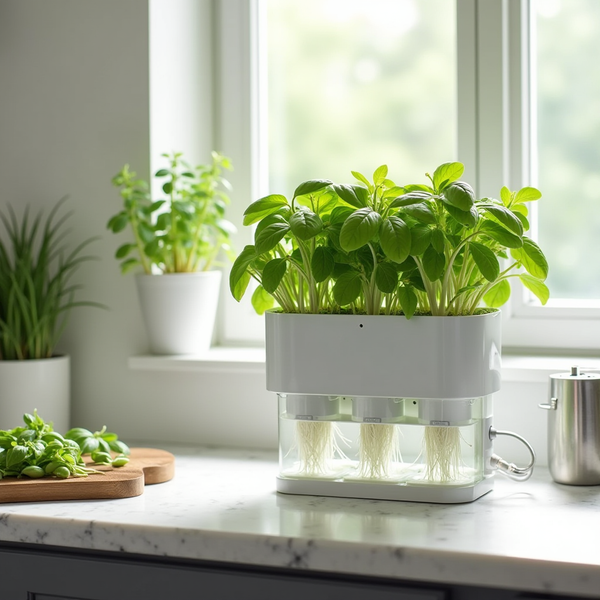
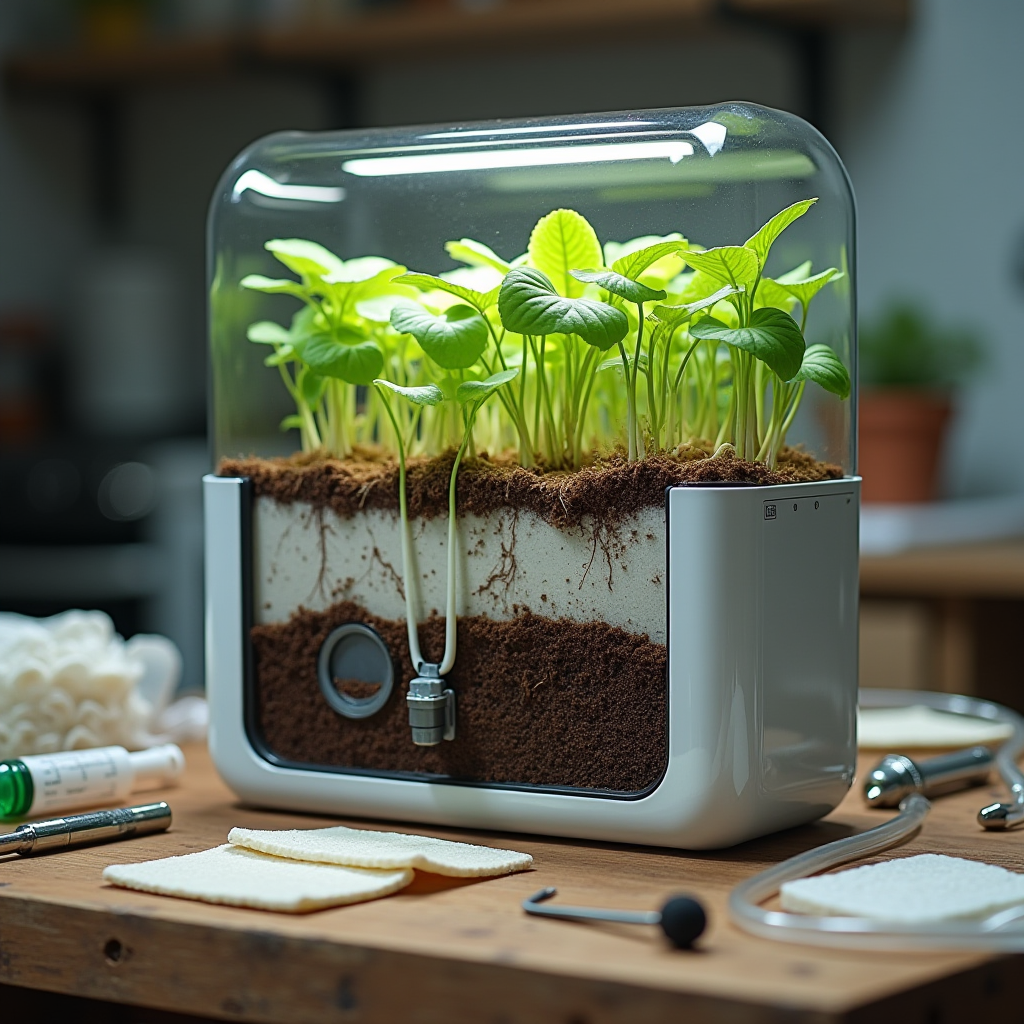
Click & Grow avoids pumps entirely and relies on capillary action through a wick. That sounds simpler, but there is still a “moving part”: the wick itself. Once the wick plugs with salts or loses contact with either the water or the media, the pod behaves like a dry houseplant in a plastic cup.
Common failure modes:
- Wick no longer fully touching the water, especially after repeated reservoir dry-downs.
- Wick fibers become hydrophobic after drying hard; water beads instead of wicking.
- Dried fertilizer salts and algae form a crust at the pod bottom, blocking capillary flow.
3. Sensors and “smart” logic
Smart gardens lean heavily on low-cost water level sensors. When those sensors drift or get fouled, you see classic symptoms:
- Unit says “water OK” but the tank is nearly empty.
- Unit says “empty” and refuses to irrigate even when full.
- Level graph in the app is flat even though you are actively topping up.
Most of these sensors are simple float-and-reed designs or basic capacitive probes. A little slime or mineral buildup is enough to throw them off.
4. Why hydrogen peroxide is not a magic cleaner
New growers often reach for strong hydrogen peroxide to “sterilize everything.” That is risky in closed, small-volume systems. As noted in this overview of hydrogen peroxide and plants, high concentrations can damage root tissues and beneficial microorganisms. Overuse in small reservoirs can burn roots, stall growth, and destabilize the root-zone ecology you actually want.
We will use safer, lower-impact cleaning methods that keep pumps and wicks clear without nuking your crop.

Practical Steps: Pump, Wick & Sensor Fixes That Actually Work
1. Gardyn pump not working fix: exact checks and flow benchmarks
1.1 Fast triage
- Confirm the Gardyn is online in the app.
- Trigger a manual watering cycle if your firmware supports it.
- During the cycle, place your hand on the base: you should feel a soft vibration and hear a low hum.
Now match what you see and hear to the condition:
- No sound, no vibration: suspect power, dead pump, or a failed controller output.
- Hum but no visible flow at the top manifold: suspect airlock or blockage.
- Weak dribble compared to normal spray: partial clogging or worn pump.
1.2 Priming steps for Gardyn and similar vertical systems
Use these steps any time you drain and refill the reservoir or move the unit:
- Fill reservoir to the max line.
- Start a manual watering cycle.
- Gently rock the whole unit front-to-back a few millimeters while the pump runs. You are trying to push trapped air out of the pump and up the main riser.
- Watch the top manifold: within 10–30 seconds you should see strong, even streams from all outlets.
If you still get no flow, pull the pump for a bucket test:
- Unplug the unit.
- Remove the reservoir cover and carefully pull the pump.
- Submerge the pump fully in a bucket of clean water.
- Plug it directly into a power strip.
- Rotate and tilt the pump underwater as it runs until air bubbles stop and the outlet produces a steady stream.
If the pump flows well in a bucket but not installed, the problem is in the plumbing, not the motor.
1.3 Flow targets and when to replace
For a Gardyn-class vertical system, you want roughly:
- Nominal pump rating: 400–800 L/h (100–200 GPH) at low head.
- Practical test: during a watering cycle, every column outlet should produce a continuous stream, not intermittent drips.
If you see outlets barely weeping or stopping while others still flow, clean the manifold and risers. If your pump is several years old and flow is weak even after cleaning, treat the pump as a consumable and replace it with an equal or slightly higher-rated model matched to your head height.
1.4 Safe cleaning protocol for Gardyn-class pumps and lines
Frequency: every crop cycle, or roughly every 6–8 weeks for continuous production.
- Drain the reservoir completely.
- Rinse out loose roots and debris.
- Mix a warm solution of water plus 1–2% white vinegar (10–20 mL per liter).
- Circulate that solution through the system for 10–15 minutes.
- Scrub the pump intake and manifold with a soft brush.
- Drain, rinse thoroughly with fresh water, then refill with nutrient solution.
A mild vinegar solution is strong enough to soften scale and biofilm but far safer to roots than aggressive hydrogen peroxide dosing. Avoid running high-strength peroxide through a planted system if you care about root health.

2. AeroGarden pump troubleshooting: getting circulation back
2.1 Know which AeroGarden you have
AeroGarden uses two main strategies:
- Air pump plus air stone (common in smaller units) to agitate and oxygenate water.
- Submersible circulation pump (common in Bounty, Farm, and larger models) to move water through channels.
Flip your unit over or check the manual. An external silicone tube leading into the bowl usually indicates an air pump design.
2.2 Symptom-based diagnosis
- Symptom: no visible water movement, silent base
Check that the power adapter is fully seated, the lights are working, and the unit is not in a scheduled off period. Unplug for 30–60 seconds and plug back in. If the pump never starts in its normal duty cycle and you hear nothing, the pump or controller output is likely dead. - Symptom: buzzing but no bubbles or flow
For air-pump models, inspect the air line for kinks and confirm the stone is not buried in roots or thick slime. Swap in a new air stone if the old one is crusted. For water-pump models, remove the bowl insert, locate the pump, and clear the intake of roots and media. - Symptom: intermittent pump, random shutdowns
Many AeroGardens intentionally cycle pumps on and off to prevent overheating. Check the official runtime pattern for your model. If your pump is cutting off outside that pattern, inspect the power brick for heat, try a different outlet, and if needed, replace the pump or complete bowl assembly.
2.3 Priming and cleaning for AeroGarden bowls
- Maintain the water level at or slightly above the “fill to here” line, especially after cleaning.
- After reservoir changes, run the pump and gently rock the unit to purge trapped air from any vertical risers.
- Between grows, run a cleaning cycle with warm water and 1–2% white vinegar. Let it circulate 10–15 minutes, then scrub and rinse thoroughly.
Target flow is simple here: look for active, visible circulation or bubbling across the entire pod deck. Stagnant corners and slimy edges are your early warning that flow is not reaching all root zones.
3. Click and Grow wick not wicking fix: restoring capillary action
3.1 Quick mechanical checks
- Confirm the reservoir is filled to the recommended level so the wick tip is submerged.
- Lift the pod holder and visually confirm that each wick is hanging straight and not kinked or folded.
- Check that at least 0.5–1 cm of wick is below the plastic divider and in contact with water.
3.2 Clearing a “dried” or salted wick
- Remove the pod with the wick still threaded through.
- Soak the lower part of the pod and wick in warm water for 10–20 minutes to rehydrate fibers.
- Gently squeeze and release the wick in the water to break up salt crusts and algae films.
- Optionally, use a very soft brush on the pod bottom to remove any visible white mineral buildup.
- Reinstall, making sure the wick has firm contact with the pod media and hangs freely into the tank.
3.3 Replacing or upgrading the wick
If you have repeated failures on the same pod position, the factory wick may be damaged. You can:
- Replace with a fresh wick of similar material and thickness (synthetic or cotton).
- Thread a longer wick so the contact area with both media and water is increased.
- In older units, consider replacing all wicks every 2–3 full crop cycles as a maintenance item.
Flow target for a healthy Click & Grow pod: media should feel evenly moist but not sopping, and the plant should not wilt between top-ups. If the top of the pod is bone-dry while the tank is full, your wick system is not working.
4. Smart garden water level sensor calibration and fixes
4.1 Cleaning and testing float sensors
- Power down the unit.
- Locate the float assembly in the reservoir and clean off all slime, roots, and scale.
- Move the float up and down by hand while the unit is powered on again and watch for changes in status LEDs or app readings.
- If the float sticks at any point, lightly sand or scrub the stem and float channel to restore smooth travel.
If you can move the float from “empty” to “full” positions and the app never updates, the reed switch or wiring is likely damaged. At that point you are into replacement-part territory.
4.2 Resetting capacitive sensors
- Completely clean the sensor area with a soft cloth to remove mineral deposits.
- Fill the reservoir to the factory “full” mark.
- Power-cycle the unit; many systems treat this as a reference state.
- Check the app for any “calibrate” or “reset water level” function and follow the prompts.
Once calibrated, verify behavior by slowly draining or dipping out water while watching the reading. If the sensor stays stuck high or low, contact support for a replacement module or board.

Pro Tips & Benchmarks: Keep Pumps, Wicks & Sensors Online Long-Term
1. Flow and runtime benchmarks for small pumped systems
For most Gardyn-class and AeroGarden-class systems, these numbers keep you in the safe zone:
- Flow rate: aim for a pump rated around 4–10 times the reservoir volume per hour. For a 10 L tank, that is roughly 40–100 L/h practical flow, adjusted for head height.
- Runtime per day: many smart systems spread watering across multiple short cycles. As a rule of thumb, having total pump-on time of 30–120 minutes per day is usually adequate for leafy greens, longer for fruiting crops.
- Visual cue: during a watering cycle, all sites should see fresh water within 30–60 seconds of the pump starting.
If you consistently see slow fill or dry spots at the top of columns, treat that as a reliability issue, not a cosmetic one. Reduced flow is often the first sign of a future failure.
2. Cleaning and disinfecting schedule that does not kill plants
For smart gardens in continuous use, stick to this rotation:
- Every 1–2 weeks: top off with fresh nutrient solution, wipe obvious slime from accessible surfaces, trim roots away from pump intakes.
- Every 4–8 weeks: do a full drain, rinse, and mild vinegar recirculation (1–2% solution), followed by thorough rinsing and refill.
- Between full crops: remove plants, run a longer vinegar cycle, and manually scrub channels and pump housings.
If you insist on using hydrogen peroxide, keep it low: on the order of 1–2 mL of 3% peroxide per liter of water, and only in an empty, unplanted system as a pre-planting rinse. Then flush completely. That aligns with the caution raised in this discussion that high doses can damage roots and beneficial microbes.
3. Sensor sanity checks and calibration rhythm
- Monthly, compare what the app or indicator claims with actual water level in the tank. If they do not match, clean the sensor zone immediately.
- After any deep clean, perform the simple calibration steps: fill to “full,” power-cycle, and run any built-in “calibrate” function.
- If a sensor disagrees with reality more than twice in a season despite cleaning, assume it is failing and either replace it or go old-school and check visually every few days.
4. Tying it back to Kratky and DWC thinking
Even though Gardyn, AeroGarden, and Click & Grow are packaged products, the same logic you would use in Kratky or Deep Water Culture applies:
- Kratky mindset: in Click & Grow, treat the wick as the “bridge” between reservoir and root zone. If the bridge is broken, the system is dry Kratky with no air gap management. Your fix is always about restoring that bridge.
- DWC mindset: in pumped systems, uninterrupted circulation and oxygenation are non-negotiable. Pump and air path uptime matter more than fancy app graphs.
- pH/EC discipline: even when the hardware is perfect, tiny reservoirs are unforgiving. Check pH and EC at least weekly. For leafy greens, stay around pH 5.5–6.2 and EC 0.8–1.6 mS/cm; for fruiting crops, pH 5.8–6.5 and EC 1.8–3.0 mS/cm, adjusting based on your nutrient brand’s guidance.
When you combine healthy flow (or wicking), accurate sensing, and tight nutrient control, these systems become what the marketing promised: small, productive, low-effort indoor gardens. When any of those three pillars slips, the plants show it fast.
As an Amazon Associate, I earn from qualifying purchases.